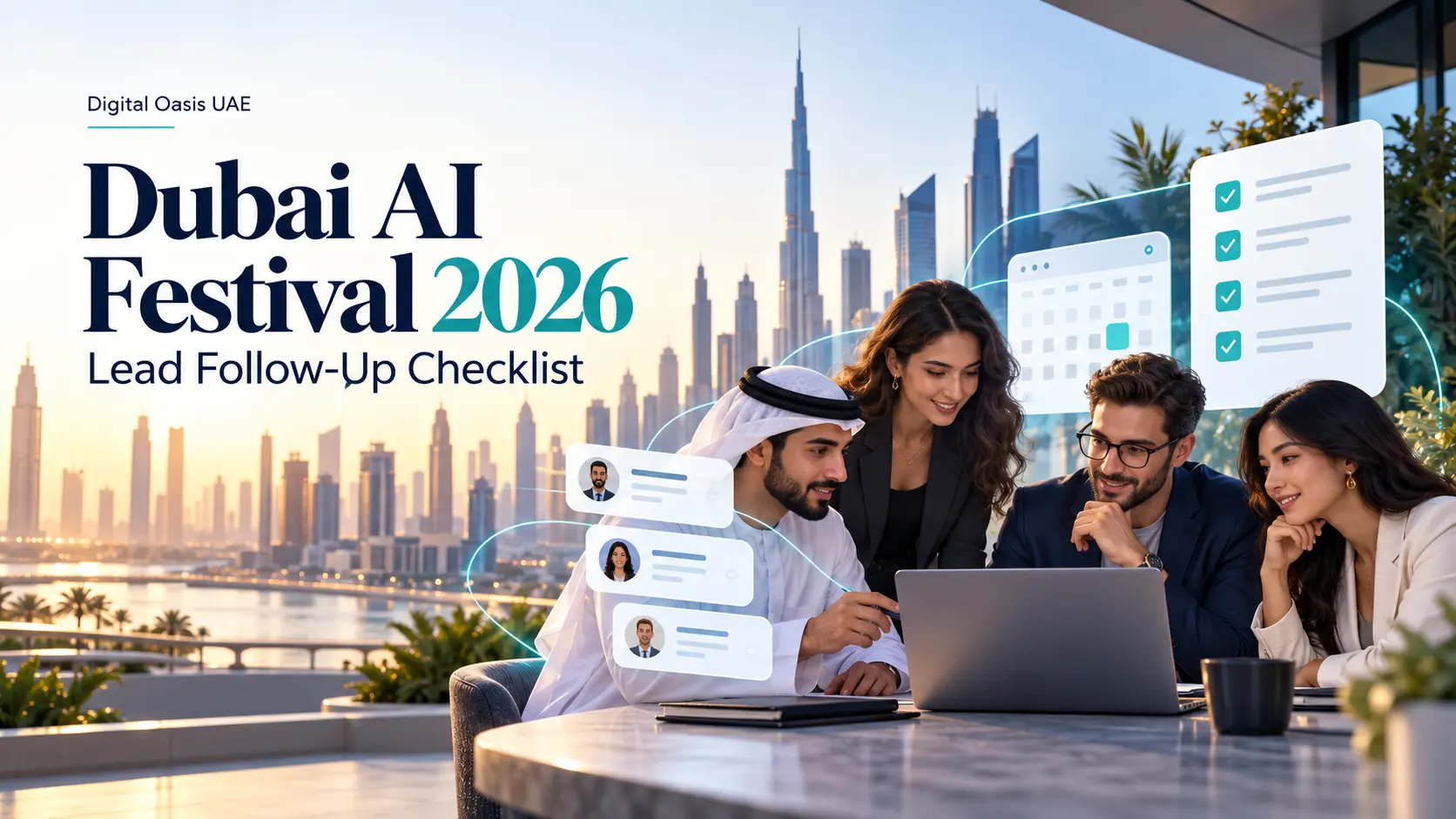
The best way to follow up after Dubai AI Festival 2026 is to capture each prospect’s business problem, assign a CRM owner, and deliver the next step you agreed on during the conversation. Prioritize requested demos and active projects, personalize your message, and measure attended meetings and qualified opportunities. Dubai AI Festival is scheduled for 26–27 October 2026 at Dubai World Trade Center, according to the official festival website and Dubai AI Campus event listing. For an AI startup or SaaS company, a promising conversation might involve a buyer, an integration partner, an investor, or someone researching the market. Each needs a different follow-up. This checklist helps founders, marketers, and sales teams turn those conversations into an organized plan.
The timings below are recommended targets, not performance benchmarks or sales guarantees.
What should you know about Dubai AI Festival 2026?
| Detail | Verified information |
| Dates | 26–27 October 2026 |
| Venue | Dubai World Trade Centre, Dubai |
| Organizer | Dubai AI Campus, according to the festival’s About page |
| Audience | Businesses, government representatives, entrepreneurs, technology leaders, and investors |
| Programme | Plenary and Innovation stages, workshops, roundtables, and startup programming |
The official agenda covers enterprise AI agents, autonomous business operations, infrastructure, banking applications, and commercial scale. Check it again before attending because session details can change. The festival’s About page explains its institutional partnerships and business focus. Use the program to prepare better questions. Someone evaluating an AI agent may need evidence about oversight and integration. A SaaS buyer may want clarity on implementation effort, user adoption, and measurable value. Your follow-up should answer the concern raised in the conversation.
Your quick event lead follow-up checklist
- Record the contact’s company, role, business problem, and requested next step.
- Separate prospective customers from investors, partners, suppliers, and general interest.
- Check for an existing account, contact, or open opportunity before adding a record.
- Assign one owner and a due date for every relevant follow-up.
- Record the preferred channel, language, and communication permissions.
- Send the promised material with a short recap and one clear next action.
- Pause automated messages when someone replies, books, declines, or opts out.
- Review attended demos, sales-accepted opportunities, and revenue over time.
1. Set up your CRM and demo journey before the festival
Create a campaign called Dubai AI Festival 2026 in your CRM. Connect new contacts to it while retaining their original acquisition source. If someone is already a customer or has an open deal, notify the existing owner instead of starting a competing sales sequence.
Agree on one main customer-facing offer: for example, a discovery call, a workflow assessment, or a demo built around a specific use case. Separate those options from an investor meeting or partnership discussion.
Test the complete journey on a phone:
- Scan the booth QR code and open the landing page.
- Submit a test enquiry and confirm that its event source is recorded.
- Check the owner assignment and follow-up task.
- Book a meeting and verify that the confirmation shows the correct time zone.
- Confirm that a booked meeting stops unnecessary reminders.
Show meeting times in Dubai time, GST/UTC+4, and offer the prospect’s local time when scheduling international attendees. Ask for their language preference rather than assuming it from their name or nationality.
A demo page should explain who the product serves, the problem it addresses, what the meeting covers, and what happens afterward. If that journey needs improvement, explore Digital Oasis’s conversion rate optimization services.
2. Capture the details that make follow-up useful
A badge scan identifies a person. Your notes explain why the conversation matters. Capture the minimum information needed to continue it accurately.
| CRM field | What to record |
| Contact and account | Name, company, role, and a verified business contact route |
| Conversation context | Where you met and the specific problem discussed |
| Use case | The workflow, team, or customer experience they want to improve |
| Current environment | Relevant tools, integration needs, or deployment constraints |
| Buying context | Their role in evaluation, stakeholders, and stated timing |
| Agreed next step | Requested resource, demo, introduction, or later check-in |
| Communication preference | Preferred channel, language, and permission record |
| Ownership | Responsible salesperson and action due date |
For example, “interested in AI” leaves the next salesperson guessing. A useful note would be: “Operations lead wants to reduce manual ticket routing; asked about integration with the existing help desk; requested an architecture overview before involving IT.” This is an illustrative scenario, not a client case study. The festival’s startup package page advertises networking-platform access with a lead-retrieval scanning option. Confirm what your package includes and how you can export data before relying on it. Have a simple backup form ready.
3. Prioritize fit and intent separately
Company fit tells you whether the prospect could benefit from your product. Intent tells you whether there is a reason to act now. A senior title alone does not establish a buying opportunity.
| Group | Qualification signal | Recommended next step |
| Active buyer | Relevant problem, plausible fit, and a requested demo or evaluation | Owner follows up the same business day or within one business day |
| Relevant but early | Suitable company, clear interest, timing or scope unresolved | Send the requested resource and ask one useful qualification question |
| Partner or investor | Integration, distribution, funding, or ecosystem discussion | Route to the relevant founder or partnerships owner |
| No current sales fit | No relevant use case or no appropriate reason for contact | Close or hold the record; do not force it into a sales sequence |
For AI and SaaS products, ask questions that reveal implementation readiness:
- Which workflow are you trying to improve, and how do you measure it today?
- What systems would the product need to connect with?
- Who will evaluate security, deployment, and commercial terms?
- Are you exploring options or working toward a specific project date?
- What evidence would help you decide whether a demo or pilot is worthwhile?
Record answers as stated. If budget, authority, or timing is unknown, keep it unknown. Do not let AI-generated enrichment turn assumptions into CRM facts.
4. Use a follow-up schedule that respects the conversation
Start with the commitment you made. A requested document should not wait for the entire team’s post-event report. A prospect who asks to reconnect next month should not receive a daily sequence.
| Timing | Action | Owner |
| During the event | Record context, confirm the next step, assign an owner | Person who had the conversation |
| Within one business day | Deliver requested material and contact active buyers | Sales or account owner |
| Days 2–3 | Review unassigned contacts, duplicates, and relevant unanswered enquiries | Sales operations and owners |
| Days 4–7 | Hold discovery calls; clarify fit and evaluation requirements | Sales with technical support where needed |
| Days 8–14 | Agree a pilot, later check-in, or closed outcome | Account owner |
| Days 30, 60, and 90 | Review opportunity progress and eventual revenue | Sales and marketing leads |
Treat this as a starting schedule. Adjust it for buying cycles, recipient preferences, and your team’s capacity. After a small number of relevant unanswered messages, stop the sequence or wait for an agreed trigger. More messages are not evidence of better follow-up.
For broader campaign planning, see our guide to B2B digital marketing in the UAE.
5. Send a message that continues the discussion
An effective post-event email contains four things: a genuine point of context, the problem discussed, something useful, and one next step. Mention a session only if you know the recipient attended it.
Email example for a requested demo
Subject: Your support-routing use case after Dubai AI Festival
Hi [First name],
Thanks for discussing [specific workflow] with us at Dubai AI Festival. You mentioned that [problem in the prospect’s own words].
Here is the [overview or resource] you requested: [link]. It explains [relevant detail] and the information we would need to assess the integration.
Would a 20-minute session with your operations and IT colleagues be useful? We can focus on [use case], deployment requirements, and what a small evaluation would need to demonstrate.
[Name and company]Email example for an interested prospect who is not ready
Subject: The integration information you requested
Hi [First name],
Following our conversation about [specific issue], here is [requested material]. The section on [topic] addresses the question you raised.
Is your team currently assessing this workflow, or would a later check-in be more useful? I can tailor the next step to your timing.
[Name and company]Replace the bracketed fields with verified details before sending. Avoid generic claims that your platform will save a fixed percentage of cost unless you can support the claim for that use case.
If the team needs help organizing segmented campaigns and useful nurture content, Digital Oasis offers email marketing services.
6. Automate reminders and routing with human review
AI can help summarize notes, draft messages, identify missing fields, and suggest next actions. The owner should check that summaries preserve what the prospect actually said and that drafts contain no invented promises.
Connected data is central to this work. HubSpot’s discussion of AI in CRM highlights the limitations created by fragmented customer information. In the UAE, Salesforce’s Dubai 2026 programme also gives prominence to agentic operations and data security. These developments make a reliable customer record a useful foundation for automation.
Start with a few understandable rules:
- A validated event inquiry creates a task for the correct account owner.
- An overdue follow-up alerts a backup owner.
- A reply or meeting booking pauses the outbound sequence.
- An opt-out suppresses further marketing through the affected channel.
- Send an uncertain AI summary or technical question to a person for review.
Use approved tools for prospect data and limit access to the people who need it. Do not upload confidential conversation notes into an unapproved AI application.
If you use WhatsApp, follow the WhatsApp Business Messaging Policy, including its permission and opt-out requirements. A phone number on a badge is not, by itself, a reason to add someone to promotional messaging. Keep follow-up relevant to the interaction and the recipient’s preferences.
7. Make the next meeting specific enough to be useful
For an AI product, a generic product tour can leave the buyer’s main concerns unanswered. Build the session around one workflow and the decision the buyer needs to make.
Before the meeting, agree on:
- The business problem and its current baseline.
- The people needed to assess the proposed solution.
- Required integrations and permitted demonstration data.
- Deployment, access-control, and oversight questions.
- What a successful next step would look like.
If a pilot is appropriate, document scope, duration, responsibilities, success criteria, and the decision at the end. For example, a team might evaluate whether an agent routes selected test tickets correctly while escalating uncertain cases. Set the actual acceptance criteria with the buyer; do not borrow a generic benchmark.
Send a short meeting recap listing agreed actions, owners, and dates. This gives both teams a shared record and helps the opportunity move forward without repeated introductory calls.
8. Measure qualified opportunities and keep attribution honest
Use a defined event cohort so your denominator does not change between reports. Track contacts, accounts, and opportunities separately: five people from one company do not automatically represent five deals.
| Metric | Calculation or definition |
| Follow-up coverage | Relevant contacts with a completed first action divided by contacts requiring follow-up |
| Qualified meeting rate | Qualified meetings held divided by unique relevant event contacts |
| Meeting attendance rate | Meetings held divided by meetings booked |
| Sales-accepted opportunity rate | Accepted opportunities divided by qualified meetings held |
| Cost per qualified meeting | Defined event and follow-up costs divided by qualified meetings held |
| Event-sourced pipeline | Opportunity value attributed to the event under your documented source rule |
| Closed-won revenue | Revenue from won opportunities under the same reporting rule |
If the total event and follow-up cost were AED 20,000 and the team held 10 qualified meetings, the cost per qualified meeting would be AED 2,000. This is an illustrative calculation, not a Dubai AI Festival benchmark.
Keep event-sourced opportunities separate from existing opportunities influenced by an event meeting. Pipeline value is not revenue, and an inquiry is not a qualified sale. If there are no qualified meetings, report that result rather than displaying a misleading zero acquisition cost.
When using paid campaigns, connect reporting to the downstream actions your team can verify. Digital Oasis’s Google Ads and PPC services can support the campaign and tracking side of that journey.
Frequently asked questions
- When and where is Dubai AI Festival 2026?
The official event website lists 26–27 October 2026 at Dubai World Trade Center. Check the organizer’s website for current agenda and attendance information before traveling. - How soon should you follow up with festival leads?
Deliver promised information promptly. A practical working target for active buyers is the same business day or within one business day, unless they request another time. This is a suggested operating standard, not a guaranteed conversion tactic. - What makes an AI or SaaS event lead qualified?
A useful starting definition is a relevant organization with a specific problem your product can address and an agreed next step. Confirm the evaluation process, stakeholders, integration requirements, and timing before treating the contact as a sales opportunity. - Can AI write the follow-up emails?
Yes, it can draft from verified notes. A person should review the business context, accuracy, product claims, and next step before sending. Never use AI to invent an earlier conversation or a buyer’s interest. - Should every scanned contact enter an email sequence?
No. First check why you collected the details, the contact’s preferences, and whether the follow-up is appropriate. Separate buyers from partners and investors, and avoid enrolling people who declined further communication. - How should you measure the value of attending?
Track qualified meetings, accepted opportunities, and eventual revenue alongside total costs. Distinguish new opportunities sourced at the festival from existing deals that the event helped progress.
Build a clear next step with Digital Oasis UAE
Before the festival, choose the offer, test the demo page, and assign follow-up ownership. After each conversation, preserve the buyer’s question and deliver the next step you agreed. Digital Oasis UAE provides PPC, email marketing, and conversion rate optimization services that can support this journey. Request an event lead-generation consultation to discuss your target accounts, landing pages, follow-up content, and measurement needs. Share your product, target customer, event plans, and current tools so the discussion starts with your requirements.