
Most websites sit in digital silence. It is a hard truth — but according to Ahrefs, 90.63% of pages on the internet get zero organic traffic from Google. The reason is not always poor writing or bad design. The root problem is almost always the same. It is the wrong keyword research strategy.
Have you ever published a well-written article only to watch it flatline in search rankings? It happens to experienced marketers, too. The content was good. The intent was right. But the keyword foundation was broken.
A solid keyword research strategy is the foundation of any successful SEO campaign. It tells you what real people are searching for, what problems they want to solve, and what language Google algorithm connects with intent. In 2026, the rules have changed again. Generative AI, Google Search Generative Experience (SGE), and Generative Engine Optimization (GEO) have changed the way content appears in search results.
At Digital Oasis, we work with brands in Dubai and across the UAE to build search strategies that perform in the current landscape. It is not about stuffing pages with terms anymore. It is about precision, intent, and structured entity optimization.
What Is a Keyword Research Strategy in 2026
A keyword research strategy is a systematic process. It pinpoints the specific search terms your target audience uses to find products, services, or solutions. In 2026, it’s more than just finding high-volume words. It now maps intent, entities, topical authority, and AI-answer eligibility.
Google’s Knowledge Graph has expanded to connect concepts, brands, people, and places as semantic entities. Your content needs to be aligned with these relationships. A keyword is no longer a phrase but a signal of context, intent, and topical relevance.
The 2026 EEAT+ framework adds Engagement as the 5th pillar of Experience, Expertise, Authoritativeness, and Trustworthiness. Google now cares about content with high engagement signals such as time on page, click-through rate, and scroll depth. Your keyword strategy has to work for the algorithm and the reader.
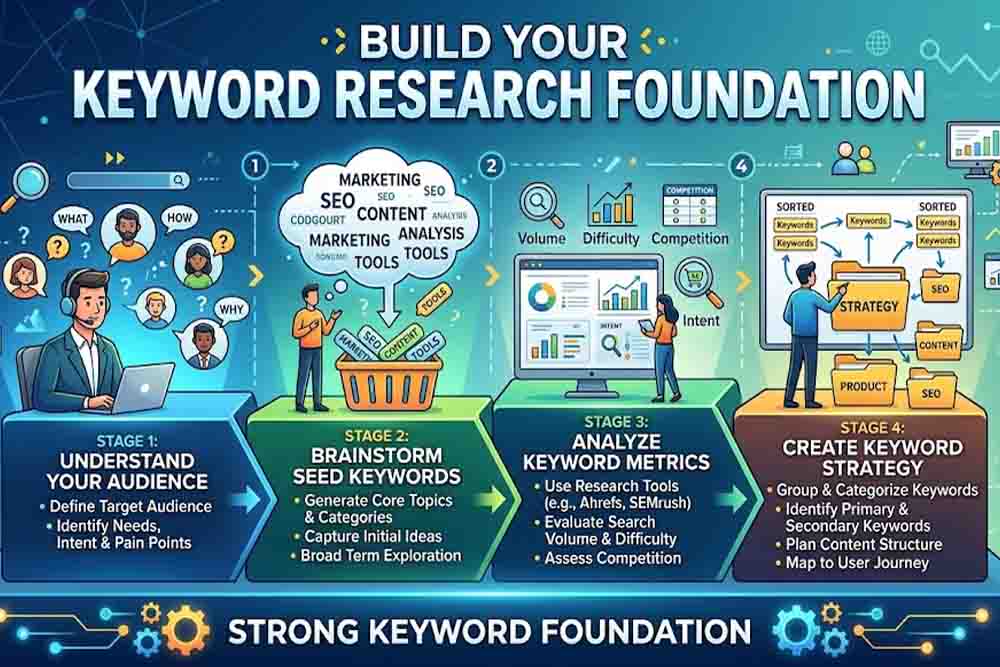
How to Build Your Keyword Research Foundation
Start with Seed Keywords and Topic Clusters
Seed Keywords are the building blocks of any good keyword strategy. They are straightforward, broad words related to your niche. If you own a digital marketing agency, your seed keywords could be SEO services or Google Ads management.
From the seed, you build topic clusters. A topic cluster groups related subtopics around one pillar page. It is how Google understands topical authority. If your website covers twenty related articles that link back to one central pillar, Google reads it as an expert source on that topic.
The key step here is to research your competitor’s keyword gaps. Tools like Ahrefs’ Keywords Explorer or SEMrush surface terms your competitors rank for — and terms they are missing. It is one of the smartest ways to find untapped opportunities.
Understand Search Intent Before Targeting Any Keyword
Search intent is the single most important factor in 2026 keyword targeting. It answers one question — what does the user actually want when they type a phrase into Google?
There are four intent types to understand:
Informational — the user wants to learn. Example: “What is keyword research?”
Navigational— user is searching for a specific website. Example: “Ahrefs login”
Commercial— user is evaluating options. Example: “best keyword research tools 2026”
Transactional— user is ready to make a purchase. Example: “hire SEO agency Dubai”
Your content must match the primary intent behind a keyword. If a keyword has commercial intent, then a blog targeting informational intent won’t rank well. Google’s algorithm is intelligent enough to recognize the mismatch.
The Role of AI and GEO in Modern Keyword Research Strategy
How AI Has Changed Search Behavior
Artificial intelligence has fundamentally changed how users search — and how Google responds. Google’s Search Generative Experience (SGE) now generates AI-powered summaries at the top of search results. It answers queries directly without requiring a click.
It sounds like bad news for organic traffic. It is actually an opportunity — if you understand how to position content for AI answers.
To appear in AI-generated summaries, your content must be structured clearly. Short, declarative sentences perform better. FAQ sections with direct answers get pulled into AI responses. Schema markup tells Google’s algorithm what type of content it is reading.
At Digital Oasis Seo service, we have seen firsthand how clients who structure content around question-based keywords earn AI snippet placements — and those placements drive qualified clicks even when organic positions slip.
GEO — Generative Engine Optimization Explained
GEO stands for Generative Engine Optimization. It is the practice of optimizing content so it appears in AI-generated answers across platforms — not just Google, but also ChatGPT, Perplexity, and Gemini.
The keyword research implications are significant. GEO-friendly keywords tend to be question-based, conversational, and long-tail. The user is having a conversation with an AI assistant, not typing a short search string.
According to research published by Mangools, long-tail keywords account for over 70% of all search queries. In AI-powered search environments, that number is climbing. It means your keyword strategy must prioritize specific, intent-rich phrases over broad, competitive head terms.
Keyword Research Tools That Dominate in 2026
The Essential Toolkit for Research
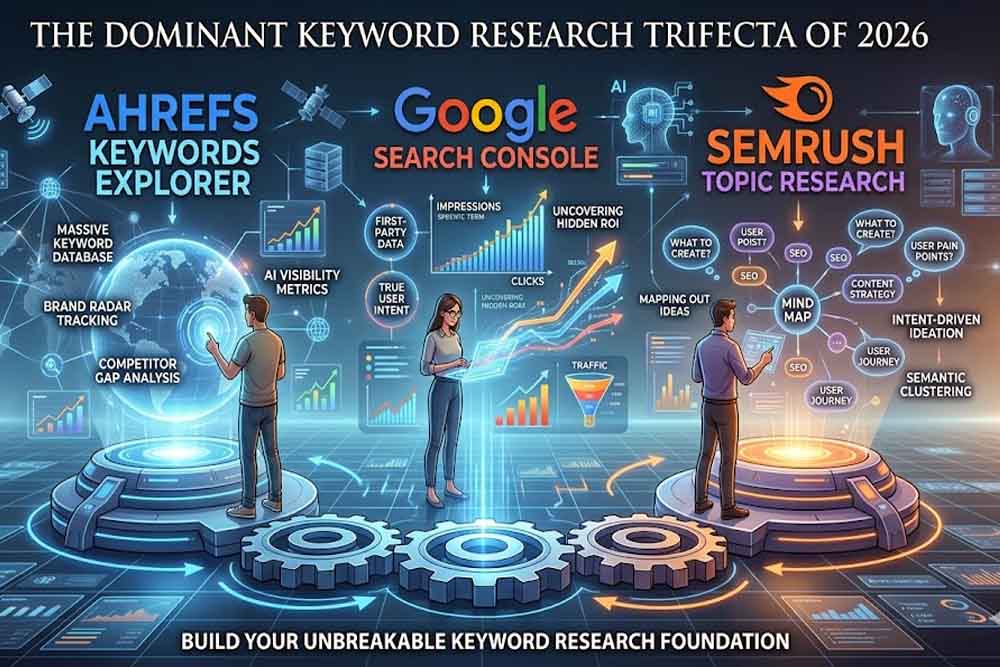
The right tools make keyword research faster and more accurate. Here are the platforms that serious SEO practitioners rely on in 2026:
Ahrefs Keywords Explorer — best for keyword difficulty scores, traffic potential, and competitor gap analysis. It shows you the keywords your rivals rank for that you do not.
Google Search Console — free and underutilized. It reveals the exact queries your existing pages already rank for. It is the first tool to check before building any new content plan.
Google’s People Also Ask — a direct window into user intent clusters. Every PAA question is a content opportunity.
Answer the Public / AlsoAsked — maps question-based keywords that align perfectly with GEO and AI search optimization.
Semrush Topic Research — builds content clusters around seed keywords and maps the full topical landscape.
It is worth noting that no single tool gives the full picture. A real keyword research strategy combines data from multiple sources and filters it through intent analysis.
How to Evaluate a Keyword Before Targeting It
Not every keyword with high volume deserves your effort. There are five factors to evaluate before committing:
Search Volume — how many people search the term monthly. Higher is not always better for new sites.
Keyword Difficulty (KD) — how hard it is to rank on page one. New websites should target KD below 30.
Cost Per Click (CPC) — high CPC signals commercial intent and advertiser competition. It is a proxy for keyword value.
Traffic Potential — the total traffic a top-ranking page earns from all related keyword variations, not just the head term.
SERP Features — does the keyword trigger featured snippets, PAA boxes, or AI summaries? Target these for higher visibility without needing position one.
Advanced Keyword Research Strategy Tactics for 2026
Semantic Keyword Clustering for Topical Authority
Google no longer ranks individual pages in isolation. It ranks websites based on topical authority. A website that covers a subject comprehensively outranks one that covers it superficially — even with fewer backlinks.
Semantic clustering groups keywords by meaning, not just by phrasing. The goal is to build a content architecture where every page reinforces every other page on the same topic.
Here is a practical example. If your pillar page targets “keyword research strategy,” your supporting cluster might include:
- How to find long-tail keywords.
- keyword intent analysis guide
- best keyword research tools for small business
- How to use Google Search Console for keyword research.
Each supporting article links back to the pillar. Each internal link tells Google that your site is the authority on the full topic — not just one phrase.
Local Keyword Research for GEO-Targeted SEO
Local keyword research is a separate discipline — and an important one for businesses serving specific regions. It means finding keywords that combine commercial intent with geographic modifiers.
Examples include: “SEO agency Dubai,” keyword research consultant Abu Dhabi,” Social marketing services UAE.”
According to MSU’s SEO guidance, local keywords with strong intent conversion at significantly higher rates than generic informational terms. A user searching “digital marketing agency Dubai” is ready to make a decision. It makes the keyword exponentially more valuable than a high-volume generic term.
For local SEO success in the UAE market, you should layer location terms across title tags, H1 headings, meta descriptions, and naturally within content — without forcing them. Google’s local algorithm rewards relevance, not repetition.
People also ask
What is a keyword research strategy?
A keyword research strategy is a structured plan to identify, evaluate, and prioritize search terms your target audience uses. It guides content creation, on-page SEO, and paid advertising decisions.
How often should I update my keyword research?
It is best practice to review keyword performance every quarter. Search trends, algorithm updates, and competitor movements shift keyword opportunities regularly.
What is the difference between SEO keywords and GEO keywords?
SEO keywords target traditional search engines like Google. GEO keywords are optimized for AI-generated answers in tools like ChatGPT, Perplexity, and Google’s SGE. GEO keywords tend to be more conversational and question-based.
How many keywords should a single page target?
One primary keyword per page is the standard approach. You can support it with three to five secondary keywords and several LSI (Latent Semantic Indexing) terms. Keyword stuffing is a ranking risk — relevance matters more than frequency.
Can small businesses compete with keyword research against large brands?
Yes. The most effective approach is to target low-competition long-tail keywords with clear intent. Large brands often ignore these terms because the volume appears low, but the conversion rate and cost efficiency are far superior.
Final Thoughts
A strong keyword research strategy is not a one-time task. It is an ongoing process that adapts to algorithm updates, shifting user behavior, and emerging AI search technologies. In 2026, the gap between websites that invest in structured keyword research and those that guess is wider than ever.
The fundamentals remain constant. Understand your audience. Map their intent. Build topical authority. Structure content for both humans and AI systems. Measure, refine, and repeat.
At Digital Oasis, we help businesses in Dubai, the UAE, and across the GCC build search strategies that produce measurable results. It is not about ranking for the most keywords. It is about ranking for the right ones — the ones that bring buyers, not just browsers.
Want to know which keywords your competitors are winning right now? Request a free SEO audit from Digital Oasis today and get a clear roadmap to dominate your niche in 2026.