

How to Use Automation for Your Ecommerce Website in 2026 (Save Time & Boost Sales)
Last month, a store owner told me something that stuck. He said, “I started the business to sell products. Now I spend half my day doing data entry.”
That is not a unique story. Talk to most ecommerce founders, and they will tell you the same thing. Orders pile up, customer emails go unanswered, inventory numbers go out of sync, and the team gets buried in tasks that repeat the same way, every single day.
The fix is not hiring more people. That just adds payroll. The real fix is to set up proper automation for your ecommerce website — the kind that handles repetitive work in the background, and lets your team focus on things that actually move the needle.
At Digital Oasis marketing agency, we have helped several online stores make that shift. This guide walks you through exactly how e-commerce process automation works, where to start, and which ecommerce automation software actually delivers results.
What Is Ecommerce Automation?
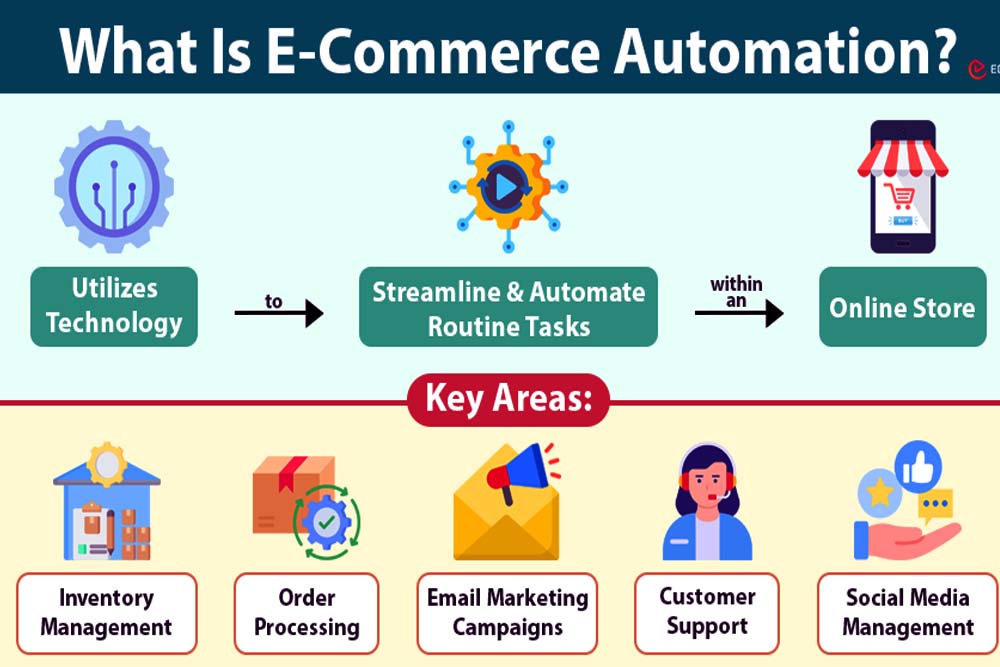
Ecommerce automation means using software to handle store tasks that follow a predictable pattern — without a human stepping in each time. Think of order confirmations, low-stock alerts, cart abandonment emails, and CRM updates. All of these can run on their own, once you set them up correctly.
The logic behind every automation is straightforward. A trigger starts the process — for example, a customer places an order. A condition decides what happens next — for example, the order total is above $500. An action then fires automatically — the system tags it as high-value and notifies your operations team on Slack.
One workflow like that can save 20 minutes per order. Across 200 orders a month, that is 66 hours saved — without spending a single extra dirham on staff.
According to McKinsey, 66% of business leaders had already piloted workflow automation for at least one process by 2020. By 2024, that number crossed 40% of businesses globally running some form of active ecommerce automation software. The stores moving fast on this are the ones pulling ahead.
Why Does It Matter for Your Online Store?
Customers today are not patient. Research from HubSpot found that 90% of shoppers expect a response to their support question in under 10 minutes. A human team cannot cover that consistently — especially across time zones, weekends, or peak sale periods.
Automation can. And beyond customer support, it directly cuts costs. Stores that implement automation tools report operational cost reductions of up to 30%. Sales productivity rises by 14.5% when teams stop handling repetitive manual work.
How Does Automation for Your Ecommerce Website Actually Work?
A lot of people think e-commerce process automation is complicated. It is not. It is basically a set of rules your store follows automatically — no coding needed, no technical team required.
Here is a real example. H&M ran a chatbot on Kik. When a customer browsed without buying (trigger), and had not purchased in 30 days (condition), the system sent a personalized message with a 10% discount (action). That one automated flow achieved an 86% engagement rate.
Most store owners are not H&M, but the same logic applies at any scale. Here is a simple ecommerce automation checklist of tasks you can realistically hand over to software right now:
Inventory level updates the moment stock drops below a set number. Order confirmation emails are sent the second a purchase goes through. Back in stock notifications are sent automatically to customers who asked for them. Follow-up messages to shoppers who leave items in their cart. Customer records sync automatically to your CRM. Shipping updates are sent to buyers without anyone pressing a button.
How many of those does your team still do by hand?
Ecommerce Order Automation — Fix the Biggest Time Drain First
Orders are the heart of any ecommerce business. They are also the biggest source of manual, repetitive work. That makes order automation the best place to start when you decide to automate your online store tasks.
A proper order automation setup handles tagging, fraud detection, fulfilment routing, and holds on suspicious transactions — all without your team reviewing each one manually.
Consider Helthjem, a Norwegian delivery company that added food ordering during the COVID-19 pandemic. Customers wanted delivery updates around the clock. The support team could not keep up. Helthjem deployed an AI chatbot for ecommerce customer support to handle those common questions automatically. The support team shifted focus to making fulfilment smoother. The result — a 25% boost in average order value, directly because service became faster and more reliable.
To set this up for your store, follow these three steps. Identify the trigger — a new order is placed. Define the condition — is it a standard order or does it have a flag? Set the action — route it to the right fulfilment partner, tag it in your system, or send a notification to your team.
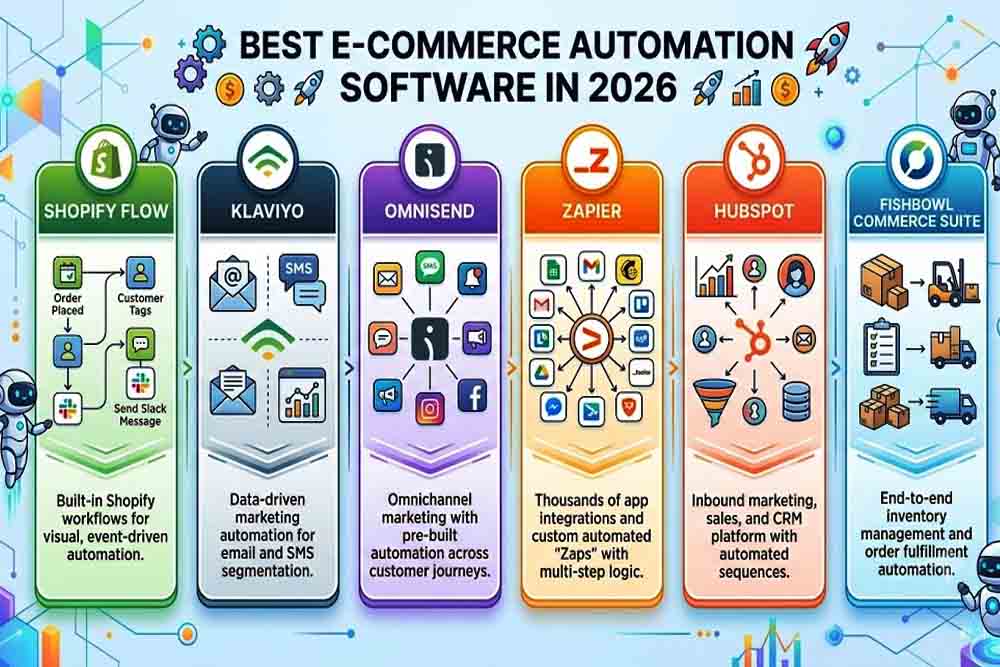
Tools like Shopify Flow, ShipStation, and Fishbowl Commerce Suite handle all of this well.
Ecommerce Marketing Automation — Turn Abandoned Carts into Revenue
Cart abandonment is money that almost happened. A shopper found your product, added it to the cart, and then left. Without a follow-up, that sale is gone. With the right automation software, it becomes a second chance.
Dressmann, one of Scandinavia’s biggest fashion retailers, tackled this head-on. The brand introduced conversational AI with custom cart abandonment email automation. The outcome — a 34% increase in website engagement and a 17% jump in average order values. No extra staff. No manual outreach. Just smart automation running in the background.
The economics of email automation are hard to argue with. Research consistently shows that every $1 spent on email automation returns between $36 and $40. And 59% of marketers report a direct improvement in ROI after adding personalization to their automated campaigns.
Here is what a solid marketing automation sequence looks like when you automate your ecommerce website properly.
A customer views a product category and leaves without buying. The system tags them. Within two hours, they receive an email showing the items they viewed plus similar ones. Three days later, if there is still no purchase, a second email goes out with a small discount or a low-stock warning.
That entire flow runs on tools like Klaviyo, Omnisend, or ActiveCampaign. It requires a one-time setup, and then it works indefinitely.
It is also worth adding back in stock notifications to your setup. When a product comes back into inventory, the system automatically emails every customer who asked to be notified. That single workflow recovers sales you would otherwise lose permanently.
Ecommerce Customer Support Automation — Serve More, Hire Less
Customer service is where most growing stores hit a wall. Orders double, but the support team cannot scale at the same pace.
Ecommerce customer support automation solves this without adding headcount. An AI chatbot handles the questions that repeat constantly — order status, return policies, delivery times, and product availability. Your human agents then focus only on complex or high-value conversations that actually need a person.
Thon Hotels ran into exactly this problem as they expanded. Their support team was overwhelmed by repetitive enquiries about room availability and booking policies. They deployed an AI chatbot to handle the common questions automatically. The result was fewer repetitive tickets, faster responses for guests, and a noticeably better experience for the support team, who now handled only the conversations that mattered.
The same principle applies to any ecommerce store. Set up your chatbot to answer FAQs, trigger order lookup responses, and route complex questions to the right team member. It is one of the highest-ROI automation moves you can make.
Best Ecommerce Automation Software in 2026
The tool you pick should match your store platform and your team’s level of technical experience. Here is a straightforward breakdown.
Shopify Flow:
It is the natural starting point for Shopify stores. It handles order tagging, fraud flags, and basic workflows at no extra cost.
Klaviyo:
Klaviyo is the strongest option for email and SMS marketing automation. It connects natively with Shopify, WooCommerce, and BigCommerce, and its segmentation features are excellent.
Omnisend:
Omnisend covers email, SMS, and push notifications in a single platform. It is the right pick for stores that want multi-channel outreach without juggling separate tools.
Zapier:
Zapier is what you reach for when two tools do not connect natively. It links your store with your CRM, accounting software, or project management tools without any coding.
HubSpot:
HubSpot is worth considering if you want CRM, email automation, and customer support all in one place. It is especially useful for stores that also handle B2B clients or repeat wholesale buyers.
Fishbowl Commerce Suite:
Fishbowl Commerce Suite is built for inventory and order management at volume. If your store handles complex supply chains or stock across multiple warehouses, this is the right fit.
Start with one tool. Build one workflow. Test it thoroughly before expanding. Adding too many systems at once leads to data conflicts and broken automations that no one notices until a customer complains.
How to Automate Your Ecommerce Store — Step by Step
The process is simpler than most people expect. Here is your practical ecommerce automation checklist to get started without feeling overwhelmed.
Map your workflows first
Write down every task your team does daily, weekly, and monthly. Mark the ones that follow the same pattern every time. Those are your automation candidates.
Match tools to your existing setup
Do not pick ecommerce automation software that requires replacing your whole tech stack. Look for options that connect cleanly with your store platform, CRM, and payment processor.
Test before going live
Run a real test order through your new workflow. Ask — what happens if the payment fails? What happens if a product goes out of stock mid-campaign? Fix those edge cases before the workflow touches real customers.
Scale gradually with conditional logic
Once a workflow is stable, add layers. Route orders by region to separate tracking sheets. Send VIP buyers to a premium CRM segment automatically. Set low-stock triggers that fire before you actually run out. Each layer compounds the efficiency.
One thing that always trips people up — data hygiene. Outdated customer records, duplicate entries, or mismatched fields across platforms will silently break your automations. Clean your data before building on top of it.
Mistakes That Kill Ecommerce Automation Before It Works
Over-automating without user control is the most common failure. Microsoft’s Clippy is the classic example — an automated helper that fired constantly and without context until users grew to hate it. Generic bulk emails sent to your entire list are the ecommerce version of that mistake.
Personalization is not optional here. A McKinsey report found that 71% of consumers expect personalized experiences from the brands they buy from. And 76% get actively frustrated when that does not happen. Automation should never mean generic. It should mean precise — the right message, the right person, the right moment.
Poor data management is the other silent killer. Outdated customer records, duplicate entries, or fragmented data between platforms will produce wrong outputs, missed orders, and frustrated customers — even when the automation itself is set up correctly.
People also ask
What is e-commerce process automation?
It is the use of software to handle repetitive store tasks — like order processing, inventory updates, and customer emails — automatically, based on pre-set rules called triggers, conditions, and actions.
What is the best ecommerce automation software?
It depends on your platform and goals. Shopify Flow is the easiest entry point for Shopify stores. Klaviyo leads for email and SMS. Zapier bridges tools that do not connect natively.
Can you fully automate your ecommerce website?
Most operational tasks — order processing, inventory updates, email sequences, CRM syncing — can run fully automated. Customer relationships and strategic decisions still benefit from human judgment.
What should be on an ecommerce automation checklist?
Start with order confirmations, cart abandonment emails, back in stock notifications, inventory sync, shipping updates, and CRM record updates. These give the highest return for the least setup effort.
How much does ecommerce automation software cost?
Shopify Flow is free with your Shopify plan. Klaviyo and Omnisend both have free tiers. More complete setups range from a few dollars a month to several hundred for enterprise platforms.
Final Thoughts
The stores that grow sustainably are not the ones with the largest headcount. They are the ones with systems that run efficiently even when the team is not watching.
Automation for your ecommerce website is not a one-day project. It starts with one workflow, one tool, and one test. Then it compounds. Every automated task your store handles on its own is time and money redirected toward growth.
At Digital Oasis, we work with ecommerce brands to build practical automation setups built around how your store actually operates — not a generic template that looks good on paper but does not fit your real workflows. If your team is still handling tasks that software can do, it is worth a conversation.
Reach out to Digital Oasis today. Let us look at your workflows together and find the fastest wins for your store.

How Is Artificial Intelligence Changing the Face of Web Design?
A few years ago, building a website meant months of back-and-forth between clients, designers, and developers. Every change, even something as small as updating a button colour required a developer’s time. It was slow, expensive, and often frustrating for everyone involved.
Today, Artificial Intelligence changing the Face of Web Design, almost everything about that process. It is not a distant future trend. It is already happening at companies of every size, in every industry. At Digital Oasis, we see this shift in nearly every project that lands on our desk.
So, the real question is not whether AI is changing web design. The question is how fast it is moving, and whether your business is keeping up.
According to DesignRush, more than 81% of developers now report higher productivity when they use AI tools in their workflow. Nearly 40% of web designers use AI tools every single day. Those numbers are not predictions. They are the current reality of the industry in 2026.
Let us walk through exactly what artificial intelligence is doing to web design — and what it means for your business website.
What Is Artificial Intelligence Changing the Face of Web Design?
It is important to start with clarity. Artificial intelligence, in the context of web design, refers to computer systems that can perform tasks normally requiring human intelligence — pattern recognition, decision-making, learning from data, and adapting to new information.
Machine learning is a branch of AI. It allows software to learn from data without needing a human to program every possible outcome. Deep learning goes a step further. It processes very large datasets through layered neural networks — similar to how the human brain processes information. Both of these technologies now sit at the core of the best AI web design tools on the market.
Machine Learning and Deep Learning: What Designers Need to Know
Machine learning handles tasks like recommendation systems, behaviour analysis, and automated testing. Deep learning is what powers more advanced work — natural language understanding, image recognition, and the kind of intelligent layout generation that platforms like Wix and Adobe Sensei now offer.
The distinction matters. A basic recommendation engine uses machine learning. A tool that can look at your brand guidelines and generate a full website layout uses deep learning. Both are valuable. The key is knowing which kind of AI your tools are actually using — and what that means for the quality of output you can expect.
AI Web Design Tools That Are Reshaping the Industry
It is one thing to read statistics. It is another to see the specific tools that are producing those results right now. Several platforms have moved well past the experimental stage.
Wix ADI, Adobe Sensei, and the Rise of Automated Design
Wix built its Artificial Design Intelligence system to select from billions of design combinations and produce a unique interface for each individual user. The system does not stop learning after launch, either. It continues to adapt the site based on user behaviour, business goals, and customer interactions over time. The practical result for a business owner is faster setup, lower design costs, and a site that actually fits their specific audience.
Adobe Sensei approaches the challenge differently. It is an AI framework embedded directly inside Adobe’s creative tools. It uses machine learning to speed up design delivery, identify layout opportunities a human designer might miss, and automate the repetitive parts of a project that slow everything down. Importantly, it does not try to replace the designer. It makes a skilled designer capable of doing more in less time, which is the right balance.
LinkedIn is another strong real-world example. The platform ran a full AI-driven overhaul of its interface. It now generates personalised job recommendations, connection suggestions, and profile improvement tips — all driven by machine learning models that process millions of user interactions every day.
How AI Removed the Need for Manual A/B Testing
Traditional A/B testing is a slow process. It requires setting up two versions of a page, waiting for enough traffic to make the data meaningful, and then analysing results — often weeks after the test began. AI-powered tools like Applitools changed this entirely. It is now possible to test visual code, track page behaviour in real time, and identify design problems almost instantly. For businesses that previously spent weeks on testing cycles, the time saving alone is significant.
According to DesignRush’s 2026 industry report, AI-driven development tools are cutting development time considerably, with adoption growing at 25.2% per year through 2030.

AI Chatbots for Websites: From Robotic to Real
Cast your mind back to chatbots from five years ago. Most of them followed a rigid script. Ask a question slightly outside the expected flow, and the bot would either give a useless response or push you toward a human agent. The gap between those early bots and what AI produces today is enormous.
How NLP Makes Chatbot Conversations Feel Human
Natural language processing is the technology that changed everything. It allows a chatbot to understand the intent behind a message, not just the words themselves. So when a user types something like “I need help with my order from last Tuesday,” an NLP-powered chatbot understands the context, the timeframe, and the implied request — and it responds accordingly.
IBM’s Watson Assistant takes this several steps further. It can analyse a business’s entire history of chat logs, build its own knowledge base from those conversations, and ask clarifying questions when needed. It can even recommend changes to conversation style based on which approaches produce better results. For any business handling a high volume of customer queries, the operational advantage is very real.
Real Numbers: What AI Chatbots Save Businesses
AI-powered chatbots are projected to save businesses $8 billion in annual costs. Real estate leads all industries in chatbot adoption at 28%, followed by travel at 16% and education at 14%. If your business operates in any of these sectors without an AI chatbot on your website, your competitors are almost certainly ahead of you already.
Voice Search Optimization: The Shift Nobody Can Ignore
Think about how many times you spoke a search query into your phone this week rather than typing it. For most people, the honest answer is — more than once. Statista reports that 8.4 billion digital voice assistants are now in active use globally. That number alone tells you everything about the direction web design must move.
Why Your Web Design Must Now Think in Spoken Language
A typed search and a spoken search are fundamentally different. People type “best web design Dubai.” They say, “Which web design company in Dubai is best for a small business?” The shift toward spoken language means longer queries, more natural phrasing, and a much heavier focus on question-based content.
AI makes it possible for websites to understand and respond to spoken intent rather than just matching keywords. It connects speech recognition with language understanding to deliver relevant answers in context. For e-commerce businesses, it creates the ability to respond to a customer’s voice query with a personalised product suggestion, in real time.
It is important to know that websites optimised for voice search must include conversational long-tail keywords, structured data markup, and fast loading speeds. Those are not just technical details. They are the foundation of how AI-enabled voice search actually works at the page level.
AI Website Personalization: Every Visitor Gets a Different Experience
There is a specific reason you open Netflix and immediately see something worth watching. A human editor did not pick that for you. Netflix uses AI to study your viewing history, compare it with patterns from users who share similar tastes, and surface exactly the content most likely to hold your attention — all before you have scrolled an inch.
The same technology is accessible to any business with a website today. AI recommendation tools track every interaction a visitor has with a site — pages visited, time spent, products clicked, searches made — and feed that data into a model that gets smarter with each visit.
The Netflix Model Applied to Your Business Website
An AI personalisation engine works by building a profile of each visitor over time. Once the model has enough data, it can predict what a user wants to see next and surface it proactively. A returning customer who always browses sports equipment sees sports equipment first. A new visitor who spent three minutes on a blog post about home office design gets related product suggestions on their next visit. The experience feels tailored because it is.
According to published data, 80% of all Netflix streaming happens as a direct result of AI-driven recommendations. That is not a feature. That is the product itself. Any business that can replicate that level of personalisation on its website has a serious advantage.
Big Data, Behaviour Tracking, and Smarter Design Decisions
AI personalization only works when there is enough data to learn from. It is important to know that approximately 59% of executives expect AI to significantly enhance their company’s big data capabilities. That is not just a technology concern — it is a web design and content strategy concern. A website built to collect and learn from user behaviour will always outperform one that starts from scratch on every visit.

AI UX Design: How Machines Are Learning to Think Like Designers
User interface design used to require a significant amount of creative effort and trial and error. A designer would sketch ideas, build wireframes, convert them to code, run tests, and revise. The process was valuable — but it was also time-consuming and expensive, especially for large websites.
AI UX design tools have changed the pace of that process dramatically. Deep learning systems can now be trained on design principles and existing page layouts. Once trained, they can generate original, functional, and visually strong interface designs without needing a human to make every decision.
Adaptive Interfaces That Change Based on User Behaviour
The most advanced AI UX services systems do not just generate a design once and stop. They continue to adapt. If data shows that users consistently skip a particular section, the system learns to de-prioritise it. If a certain layout produces higher engagement on mobile, the system applies that logic across similar pages. The result is a website that gets better at serving its visitors over time — automatically.
LinkedIn, Adobe, and Real Brands Doing This Right Now
LinkedIn’s redesign is one of the clearest public examples of AI UX in practice. The platform analysed billions of user interactions to identify which features people actually used, which layouts produced the most engagement, and where users were dropping off. It then used those insights to drive a full interface overhaul. The AI did not replace the design team — it gave the design team better information than any manual research could have produced in the same timeframe.
Adobe Sensei is another live example. It actively helps designers discover layout opportunities that human eyes tend to miss, automates tedious production tasks, and delivers relevant output for each stage of a project.
The Future of Web Design: Where AI Is Taking Us Next
AI-powered web development is projected to reach $31.5 billion by 2033, growing at 25.8% annually from 2024. That is not a small shift — it is a structural change to how websites are built, maintained, and improved. Businesses that treat AI as an optional upgrade today will find it a mandatory baseline within a few years.
Ethical Questions Every Business Must Answer
It would be dishonest to discuss AI in web design without addressing the real concerns that come with it. AI systems collect and analyse large amounts of personal data. That creates genuine obligations around privacy, consent, and transparency. Algorithmic bias is also a real issue — a model trained on unrepresentative data can produce outcomes that are unfair to certain groups of users.
The right response is not to avoid AI. It is to use it responsibly. Clear data policies, transparent AI decision-making, diverse training datasets, and regular auditing of outputs are non-negotiable for any business that takes user trust seriously.
Research published by ResearchGate on AI opportunities and challenges in web design makes this point clearly: responsible AI use requires a deliberate balance between innovation and ethical standards. The companies that get this balance right will build stronger long-term relationships with their customers.
What Human Designers Still Do Better Than Any Algorithm
AI is genuinely powerful. It is also genuinely limited. Creative strategy, brand storytelling, emotional resonance, and the kind of nuanced judgment that comes from understanding a client’s full business context — these are still firmly in human territory. The best approach is always a combination: AI tools handling the data-heavy, repetitive, and analytical work, with skilled human designers making the decisions that require genuine creative intelligence.
At Digital Oasis, that is exactly how every project is run.
People also ask
Can AI fully replace human web designers?
The short answer is no. AI tools are genuinely useful, but a skilled designer who understands your brand, your customers, and your market brings something no algorithm can replicate. Creative judgment, emotional intelligence, and strategic thinking are still very much human territory. AI is a powerful assistant — it is not a replacement.
What are the best AI tools for web design in 2026?
Adobe Sensei remains one of the strongest options for intelligent design automation. Wix ADI works well for anyone who needs a professional-looking site without deep technical knowledge. Applitools has completely changed how visual testing works. For chatbots, IBM Watson Assistant is still one of the most reliable choices available. On the development side, GitHub Copilot and Cursor IDE are what most developers reach for daily.
How does AI actually improve website user experience?
It tracks what each visitor does — which pages they visit, how long they stay, where they click, and what they search. Over time, it builds a picture of what that person actually wants. The next time they visit, the site serves them content and products aligned with their behaviour. It feels personal because it genuinely is personal.
Is AI web design affordable for small businesses?
It is — and honestly, small businesses have the most to gain here. A few years ago, a quality website took months and a significant budget. AI tools have brought both the timeline and the cost down considerably. Platforms with built-in ADI let a small business owner get a polished, functional site running far faster than the old process ever allowed.
How does a website get ready for voice search?
People type one way and speak another. Someone types “best running shoes.” The same person says, “What are the best running shoes for someone with knee pain?” AI bridges that gap by understanding spoken intent rather than just matching keywords. A voice-ready website needs conversational content, structured data markup, and pages that load fast — because voice search users expect instant answers.
What are the real risks of using AI in web design?
Data privacy is the biggest one. AI systems collect a lot of user information, and if your data policies are not clear and transparent, you will lose user trust quickly. Algorithmic bias is another genuine concern — if the model was trained on limited or unrepresentative data, its decisions will reflect that. The answer is not to avoid AI. It is to use it with proper human oversight, clear policies, and regular review of what the system is actually producing.
Final Thoughts
The question of whether artificial intelligence will change web design has already been answered. It has changed it — substantially, and the pace of that change is still accelerating.
The more relevant question now is whether your website is positioned to take advantage of what AI makes possible. Personalised user experiences, smarter chatbots, voice-ready content, adaptive interfaces, and faster design cycles are not premium extras reserved for large companies. They are becoming the standard expectation for any serious business website in 2026.
At Digital Oasis, it is our job to help businesses navigate this shift without getting lost in the noise. Claude AI is a powerful tool. Paired with experienced designers and developers who understand both the technology and your business, it produces results that neither could achieve alone.
Your website is your most valuable digital asset. It is worth making it as intelligent as the technology now allows.

How to Use Google Trends to Boost Your SEO Like a Pro
Here is a question worth thinking about. What if the best SEO tool you have ever needed was already sitting in front of you — completely free — and you just never took it seriously?
That is Google Trends to boost your SEO. No subscription. No trial period. No credit card. And yet, most website owners either skip it entirely or open it once, feel lost, and never return. That is a costly habit. The brands that understand how to read Google Trends properly are consistently one step ahead. They know what their audience wants before the audience even types it into Google.
At Digital Oasis Ads services, we have built content strategies around Google Trends data for clients across the UAE. The patterns it reveals are things standard keyword tools simply cannot show. Real-time interest shifts. Seasonal momentum. Regional search behavior. Today, the goal is to show you exactly how to put it to work — practically, step by step.
Google Trends Keyword Research: Stop Guessing What People Search
Most keyword tools show you data from the past. Google Trends shows you what is happening right now. That gap — between yesterday’s data and today’s search behaviour — is where your competitors lose and you can win.
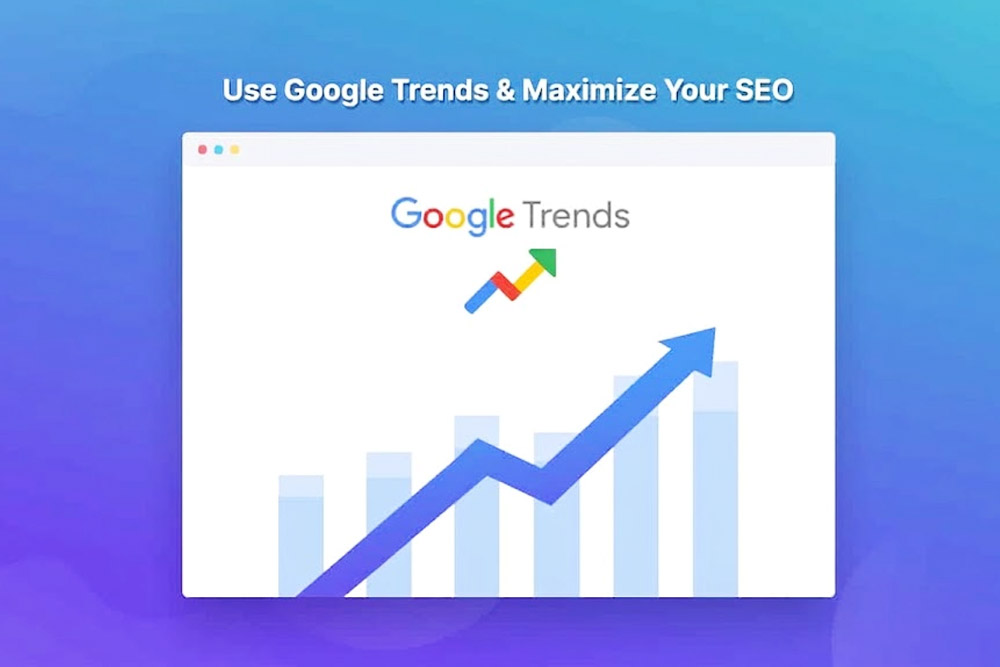
It is important to understand what the scores in Google Trends actually mean. The tool does not display raw search numbers. It works on a scale of 0 to 100. A score of 100 represents peak search interest for that term in your chosen time range. A score of 50 means half that interest. A score of 0 means almost nobody searched for it.
Now, the most valuable section on the entire page is the Related Queries panel at the bottom. Head straight there after typing your topic. Sort by “Rising” and look for anything marked “Breakout.” Google uses that label for terms whose search interest has grown by more than 5,000 percent. It is essentially Google telling you — people are searching for this right now, and almost nobody has written about it yet.
A 2024 Semrush study found that content published during the rising phase of a trend earns 3.5 times more organic traffic than content published after the peak. So the window matters enormously. Get in early, and the traffic compounds. Get in late, and you are writing for an audience that has already moved on.
Trending Topics SEO: Publish at the Right Moment and Let Timing Do the Work
Good content published at the wrong time barely moves. Average content published at exactly the right moment can rank fast and hold that position for months. Google Trends to Boost Your SEO is the only free tool that helps you nail the timing every single time.
Here is a real example. Say you run a fitness store in Dubai. Every year, search interest for “home gym equipment” climbs sharply in January and again in September. If you publish your article in November — before the January spike arrives, your page has six weeks to get indexed, earn early links, and build relevance. By the time searches peak, your content is already positioned on page one.
It is worth using the comparison feature inside Google Trends regularly. It lets you plot up to five keywords on the same graph at the same time. You can see clearly which term is gaining momentum and which one is already fading. That comparison should directly drive your editorial decisions each month.
A HubSpot study from 2025 found that brands with a data-driven content calendar generated 67 percent more organic leads than those relying on guesswork. Google Trends to Boost Your SEO is the most accessible way to build that calendar — and it costs absolutely nothing.
Google Trends Content Strategy: Know the Difference Between a Spike and a Trend
Not every rise in search interest is worth chasing. Some topics spike for a week and vanish. Others climb steadily for years. Your content strategy needs to treat both differently — and Google Trends is the tool that tells them apart.
A spike is a short burst. Something goes viral, gets covered by every news outlet, and collapses just as fast. A trend is a sustained directional shift. Interest grows gradually and holds over time. Spike content works well for quick social media posts. Trend content is what you invest serious writing time into.
To tell them apart, change the time range in Google Trends to five years. A flat or slowly rising line over that entire period means you have a topic worth a long-form SEO investment. A sudden sharp peak that drops straight back down means treat it as a quick-format opportunity only.
Digital Oasis, we used exactly this method for a UAE client in the home services space. “Smart home installation Dubai” had been on a quiet but consistent upward trend for nearly three years. We built a full pillar page around it. It ranked on page one for four related keywords within five months. The traffic has grown every quarter since. That result came entirely from reading trend data correctly before committing to the content.
Seasonal SEO Trends: Plan Months Ahead and Own the Traffic Window
Every audience has seasonal SEO trends, moments when their search behaviour shifts in predictable ways. Google Trends maps those patterns across years of data. It is one of the most reliable planning tools available — and almost nobody uses it properly.
It is important to look at three to five years of data rather than a single year. One year can be distorted by unusual events. Three years reveal the true pattern. Once you see it clearly, your content calendar plans itself.
For UAE businesses, the seasonal signals are very defined. Ramadan brings sharp rises in modest fashion searches, food delivery, and charitable giving content. January drives fitness, electronics, and travel interest. The Dubai Shopping Festival creates a concentrated surge in product comparison and deal searches across dozens of categories. If your content is not live and indexed before those windows open, someone else captures the traffic that should have been yours.
It is also worth using the regional filter inside Google Trends. For a business operating across the UAE, it shows whether a topic trends more strongly in Dubai than Abu Dhabi or Sharjah. That level of local detail is not available anywhere else for free.
Google Trends to Boost Your SEO Competitor Analysis: Find the Gaps Your Rivals Cannot See
Google Trends is not only a keyword tool. It is also a quiet but effective way to understand what is happening with your competitors — and most brands never think to use it this way.
Here is the approach. Type a competitor’s brand name into Google Trends. Then compare it against your own brand or against your main product category. The graph tells you something important. Is their brand interest growing, flat, or in decline? Are there moments when their interest spikes — a campaign, a launch, a press mention? What happens to category-level interest when their brand searches go up?
It is also useful to track a competitor’s core content theme over five years. If interest in that theme is declining, the market is shifting. The question worth asking is — where is that interest going instead? The answer almost always reveals a content gap that you can move into before anyone else does.
Bright Edge’s 2025 SEO report confirmed that 68 percent of all online experiences begin with a search engine. The brands that understand search behavior at the trend level — not just the keyword level — stay ahead of that number consistently.
People Also Ask
Is Google Trends actually useful for SEO in 2026?
Yes, genuinely. It shows real-time and historical search interest that standard keyword tools miss entirely. It helps with content timing, seasonal planning, keyword momentum, and competitor tracking — all at no cost.
How often should I check Google Trends for my SEO?
A weekly check is ideal for catching emerging topics early. Monthly is the minimum if you want to keep your content calendar accurate and ahead of seasonal demand.
Can Google Trends replace tools like Ahrefs or Semrush?
It should not replace them. It should work alongside them. Google Trends adds directional momentum and real-time context that volume-based tools cannot provide on their own.
How do I find trending keywords in my niche?
Type your main topic, set your country and time range, then go straight to Related Queries. Filter by Rising and look for Breakout labels. Those are your highest-opportunity targets right now.
Does Google Trends work for local SEO in the UAE?
Yes. The regional filter shows interest by country and sub-region. For UAE businesses, it reveals whether a topic trends differently across Dubai, Abu Dhabi, and Sharjah — and lets you plan location-specific content around those differences.
Final Thoughts
Google Trends has been free since 2006. Most people still treat it as a side curiosity rather than a core strategy tool. That gap — between those who use it well and those who do not — is exactly where real competitive advantage lives.
The approach is not complicated. Find keywords before they peak. Publish content to meet demand at its highest point. Build long-form pieces around sustained multi-year trends. Plan seasonal content months in advance. Watch competitor brand interest to catch market shifts early. None of these steps needs a big budget or a technical background. They need consistency and attention.
At Digital Oasis, trend intelligence sits at the foundation of every SEO strategy we build for UAE clients. It is not an optional extra. It is how we make sure content earns traffic from day one — not just from luck, but from timing backed by real data.

Google Ads for eCommerce in Dubai: Maximize ROI with PPC
Let me ask you something straight. Have you spent money on Google Ads, watched the budget disappear, and gotten almost nothing back? If yes, you are not alone. Hundreds of Dubai store owners share that exact story. And here is the truth — the problem is rarely Google Ads itself. The problem is almost always the strategy sitting behind it.
Dubai’s e-commerce market crossed USD 5.5 billion in 2024. Statista projects it will hit USD 9.2 billion by 2027. The opportunity is massive. So is the competition. Every click costs money. Every dirham has to work harder than the one before it. At Digital Oasis marketing services, we audit campaigns related to Google Ads for eCommerce in Dubai regularly. The same three problems show up every single time — poor structure, missing tracking, and weak ad copy. Fix those three things, and the results follow fast.
So let me walk you through exactly what works. Step by step. No fluff.
Dubai eCommerce PPC Strategy: Why This Market Is Different From Everywhere Else
A PPC strategy built for London or New York will not survive Dubai. It is that simple. Dubai is home to more than 200 nationalities. Some buyers search in Arabic, some in English. Some are luxury shoppers, some are deal hunters. And almost all of them are on their smartphones for more than 7 hours a day. DataReportal’s UAE Digital Report 2025 confirms this.
So your targeting has to reflect that reality. Evening hours and the time after Isha prayer are peak engagement windows in Dubai. Ramadan, Dubai Shopping Festival, White Friday, and National Day are the four seasons when your ad budget and reach both need to go up. Miss those windows, and your competitors will take the sales that should have been yours.
Now here is the good news. UAE consumers come to Google with strong purchase intent. The average click-through rate Google Ads for eCommerce in Dubai sits at 4.2 percent — well above the global average of 3.17 percent, according to Word Stream’s 2025 industry benchmarks. Higher intent means higher reward. The market is ready. Your strategy just needs to meet it.
Google Shopping Ads Dubai: Put Your Products Directly in Front of Buyers
If your store sells physical products — clothing, electronics, home décor, beauty — Google Shopping Ads are your most powerful tool. These ads appear with a product image, price, and store name right at the top of search results. A buyer sees exactly what they are getting before they ever click. It removes friction. It raises purchase intent. It converts better than standard text ads for product-based stores.
The setup runs through Google Merchant Center. You upload a product feed, set your bids, and Google matches your products to relevant searches. The trap most Dubai store owners fall into is submitting a poorly built feed. Vague titles, missing GTINs, wrong categories — and Google either rejects your ads or buries them where no one looks.
One simple rule to remember. Stop writing “Blue Dress.” Write “Women’s Blue Chiffon Maxi Dress — Evening Wear — Available in Size S to XL.” Google reads your product feed like a structured database. The more specific your titles and descriptions are, the better your placements become.
A tip from the Digital Oasis team — use Supplemental Feeds to A/B test product titles without touching your main feed. It is a low-risk way to improve CTR without disrupting live campaigns.
PPC Management Dubai: How Smart Bidding Saves Your Budget
Manual bidding had its time. In 2026, the conversation is about Smart Bidding — Google’s AI-driven system that adjusts bids in real time based on signals that no human can manually track. For Dubai eCommerce brands, two strategies matter most. Target ROAS and Maximize Conversion Value.
Target ROAS is straightforward in concept. You tell Google, “For every AED I spend, bring me this much in revenue.” But the setting has to be right. Set it too high, and your ads will almost never show. Set it too low, and you overpay for low-value orders. The right number only comes from real data. And real data requires at least 30 to 50 conversions per month before Smart Bidding can learn properly.
It is critical to understand one thing before any of this works — conversion tracking has to be set up correctly before you launch. Google Tag Manager and GA4 together need to fire a purchase event every time a sale happens on your store. Without that, Smart Bidding has no signal. You have no visibility. And every dirham of insight disappears.
At Digital Oasis, we once audited a Dubai electronics store spending AED 30,000 per month with zero conversion tracking in place. Months of data — gone. Every decision that the team made was a guess. Do not let that be your story.

E-commerce Advertising UAE: Campaign Structure That Actually Delivers ROI
Campaign structure is the backbone of every successful Google Ads account. A messy structure causes keywords to compete against each other, quality scores drop, and your cost per click goes up. A clean structure keeps ads relevant, clicks affordable, and conversions consistent.
The three-tier structure works best for UAE eCommerce stores.
The first tier is Brand Campaigns. Always bid on your own brand name. It is inexpensive, and it is essential. In Dubai’s market, large players like Noon and Amazon.ae actively bid on competitor brand names. Your branded traffic should stay yours.
The second tier is Category Campaigns. These target high-intent, non-branded searches like “buy running shoes Dubai” or “cheap laptops UAE.” Use Exact Match and Phrase Match keywords here. Broad Match can work, but only with a strong negative keyword list to filter out irrelevant traffic. Without that list, your budget bleeds on searches that will never convert.
The third tier is Competitor Campaigns. Bidding on a competitor’s brand name is legal, ethical, and effective. The buyer is already in comparison mode — so show up with your strongest value. Free delivery, better price, faster dispatch. Do not attack the competitor. Just make yourself the obvious better choice.
Dubai Online Store Ads: Writing Copy That Makes UAE Shoppers Click
Good ad copy does not shout. It speaks directly to what the buyer wants at that exact moment. Dubai shoppers respond to specificity. “Same-day delivery to Dubai Marina” outperforms “Fast shipping” every time. “Only 3 left in stock” creates urgency in any language. A price anchor — “Starting from AED 99” — pushes clicks up dramatically.
Responsive Search Ads allow up to 15 headlines and 4 descriptions. Google tests the combinations and learns which perform best over time. It is important to treat every headline as a standalone statement. Do not write headlines that only make sense when read together.
Lead with your strongest value in Headline 1. Put a clear call to action in Description 2 — something like “Shop Now and Get 10% Off Your First Order.”
Here is a real result from our work at Digital Oasis. A Dubai electronics retailer had a CTR of 2.8 percent. We added two things to their headlines — “Ships within 24 Hours” and “COD Available.” The CTR jumped to 5.6 percent. Cash on delivery is a trust signal in the UAE market. Buyers see it and feel the store is reliable. It was a small change. The result was more than double the previous performance.
Google Ads ROI Dubai: Track It, Attribute It, Scale What Works
Measuring ROI is not as simple as checking last-click conversions. A customer might discover your store through a Display Ad on Monday. Click a Shopping Ad on Wednesday. Convert through a branded search on Friday. So which channel deserves the credit?
Data-Driven Attribution answers that question properly. It distributes conversion credit across all touchpoints based on their actual contribution to the sale. It is far more accurate than Last Click, which still dominates in under-optimised accounts. Google recommends switching to Data-Driven Attribution once you reach around 300 conversions per month — that is, when the model has enough data to be reliable.
Scaling also has a right way and a wrong way. It is not just about raising budgets. First, identify which campaigns are consistently hitting Target ROAS. If a campaign holds that performance for 14 days straight, increase the budget by 15 to 20 percent. Give it 7 more days to stabilise. Then scale again. Doubling a budget overnight disrupts Smart Bidding’s learning phase and can tank performance for weeks. Patience here is a strategy — and it pays.
People Also Ask
How much should a Dubai eCommerce store spend on Google Ads?
A starter budget of AED 3,000 to 5,000 per month is reasonable for initial testing. Stores in competitive categories like fashion or electronics typically spend AED 15,000 to 50,000 or more per month to get meaningful reach and results.
Are Google Shopping Ads better than Search Ads for eCommerce in the UAE?
For product-based stores, Shopping Ads generally deliver higher CTR and lower CPC than standard Search Ads. They work best alongside Search campaigns, not as a replacement for them.
Can I run Google Ads in both Arabic and English for my Dubai store? Yes, and you should. Separate campaigns for Arabic and English audiences let you tailor copy, landing pages, and bids to each group. Arabic campaigns often show lower competition and CPC in many UAE product categories.
What is a good ROAS for Google Ads in Dubai?
A 4x ROAS — meaning AED 4 in revenue for every AED 1 spent — is a healthy benchmark for most Dubai eCommerce categories. High-margin categories like fashion and beauty can profitably target 6x to 8x ROAS.
How long does it take for Google Ads to work for an e-commerce store? Most campaigns need 30 to 60 days to exit the learning phase and deliver stable results. Budget for at least 90 days before drawing firm conclusions about what is or is not working.
Final Thoughts
Google Ads for eCommerce in Dubai is not complicated. But it demands precision — in campaign structure, in ad copy, in conversion tracking, and in the patience to let data accumulate before making big decisions.
The brands that win in Dubai’s digital market are not always the ones with the biggest budgets. They are the ones with the sharpest strategies. They know their audiences. They test constantly. They measure everything. And when something works, they scale it the right way.
If managing all of that on top of running an online store sounds like a lot, that is exactly why Digital Oasis exists. We have helped Dubai eCommerce brands move from burning budget to building consistent, scalable paid growth. We do not believe in cookie-cutter campaigns. Every strategy we build is rooted in your margins, your customers, and your actual revenue goals.
Shared Budgets In Google Ads: What Is It and How It Works
Most advertisers do not think about shared budgets until they run into a problem. One campaign burns through its daily limit by 11 AM. Another spends almost nothing. At the end of the month, the numbers look fine on paper, but you know you left real money and real clicks behind.
That gap between what you spent and what you could have earned? A shared budget often closes it.
At Digital Oasis PCC services, we manage Google Ads accounts for businesses across the UAE, from small retailers in Dubai to service companies running campaigns across multiple Emirates. Shared Budgets In Google Ads come up in almost every account audit we do. Most people have never touched them. And most people, once they understand how they work, wonder why they waited.
So let us get into it — clearly, practically, without the jargon.
What Is a Shared Budget in Google Ads?
A shared budget is exactly what it sounds like. It is one daily budget amount that covers multiple campaigns at the same time. Instead of telling Google “Campaign A gets AED 100, Campaign B gets AED 80, Campaign C gets AED 60, you say here is AED 240 — use it where it matters most.”
Google then decides, in real time, how to spread that money across the campaigns you have assigned to the shared budget. If demand is high for one campaign on a particular day, it gets more. If another campaign is quiet, it gets less. The money follows the opportunity.
It is a surprisingly simple idea that most advertisers overlook for months or even years.
According to Google’s official documentation, shared budgets are compatible with Search, Display, Shopping, and Video campaigns — but they do not work with Performance Max or Smart campaigns.
Where to Find Shared Budgets in Your Account
Look for “Shared Library” in the left-side navigation panel of your Google Ads account. Click on it, then select “Budgets.” That is where all your Shared Budgets in Google Ads live. You can create new ones, edit existing ones, and see which campaigns are assigned to each.
It is a part of the interface that most advertisers scroll past without clicking. Now you know it is there.
How Does a Shared Budget Work in Google Ads?
Here is the practical side of it. Once you assign campaigns to a shared budget, Google’s algorithm takes over the distribution. It looks at auction activity, how many searches are happening, how competitive the space is, and how each campaign has performed recently.
Based on all of that, it decides how much of the pool each campaign should draw from — hour by hour, day by day. No campaign gets a guaranteed slice. Each one draws from the same fund based on real-time demand signals.
Do you know what that means in practice? It means a campaign does not waste budget on a slow day just because you pre-assigned it a fixed amount. And it means a campaign does not run dry on a busy day just because its individual cap was too tight.
What Happens When the Shared Budget Runs Out?
All campaigns assigned to that shared budget stop serving ads for the rest of the day. It is not campaign by campaign — all of them pause together when the pool hits zero.
It is important to keep that in mind when you set the budget amount. A shared budget that is too small will throttle every campaign in the group. Set it too low, and you hurt all of them at once, not just one.
A solid starting point is to add up what each campaign would need individually on a typical day, then use that combined number as your shared budget. From there, tune it with real data.
Benefits of Using Shared Budgets in Google Ads
Let us talk about why this feature is worth your attention. There are three main advantages, and each one addresses a real problem that manual budget management creates.
It Saves Time — a Lot of It
If your account has ten campaigns and you adjust budgets manually every few days, that is a time cost that adds up fast. A shared budget means you touch one number, and the change applies everywhere. For anyone managing a busy account — or multiple client accounts — it is a meaningful relief.
It Lets Google Do What Google Does Well
Google’s algorithm is genuinely good at reading real-time auction signals. A shared budget gives it the flexibility to act on those signals. Instead of being locked into fixed per-campaign amounts, the system can redirect spend toward whatever opportunity is strongest at any given moment.
You are not giving up control. You are giving Google a bigger canvas to work with — and trusting it to put the money where the traffic is.
It Reduces Budget Waste
Fixed budgets create a structural problem. A campaign that hits its cap at noon has nothing left for the afternoon. If that campaign’s best traffic comes later in the day, you miss it entirely. A shared budget helps avoid that situation because the system distributes funds dynamically rather than locking them to a campaign-level ceiling.
According to a 2024 WordStream PPC industry report, accounts using shared budgets in well-structured campaign groups reported up to 15% lower average CPCs compared to identical accounts using individual caps. That is not a small difference.
How to Set Up a Shared Budget in Google Ads
The setup takes about three minutes. Here is the exact path to follow.
Log in to your Google Ads account. On the left navigation panel, click “Shared Library.” Then click “Budgets.” In the top-left corner, click the blue plus button to create a new shared budget. Give it a name that tells you what it covers — something like “UAE Product Campaigns Q3 2026” works better than “Budget 1.”
Enter the daily budget amount. Then scroll down to the campaign list and select the campaigns you want to assign. Save it. That is the entire process.
One thing to do immediately after — go into each assigned campaign and remove the individual daily budget from it. If you leave the old budget in place, Google can get confused between the two references. Clean it up right away.
Shared Budget vs Individual Budget — Which One Should You Choose?
Honest answer — it depends on your account structure. Shared Budgets In Google Ads are not always the right call. There are situations where individual budgets are the better choice, and it is worth being clear about that.
When Individual Budgets Make More Sense
Keep individual budgets when your campaigns have fundamentally different goals. A brand awareness campaign and a performance-based direct-response campaign should not share a pool. Their KPIs are different, their traffic patterns are different, and letting Google mix their spend freely can hurt both.
Also, during high-stakes seasonal moments — Ramadan, Eid, Black Friday, UAE National Day — certain campaigns deserve their own ring-fenced budget. You do not want a quieter campaign drawing from the same pool as your peak-season hero campaign.
When Shared Budgets Make More Sense
Groups campaign together when they share a common goal and a similar audience. Multiple product-category campaigns for one e-commerce brand. Several location-based campaigns for a business with branches in Abu Dhabi, Dubai, and Sharjah. A set of related keyword campaigns targeting the same conversion funnel — all of these are strong candidates for a shared budget.
At Digital Oasis, we ran a 30-day shared budget test for a retail client in Dubai. Three campaigns — same product line, different match types. The shared budget setup reduced wasted spend by 22% while total conversions stayed flat. That is a genuine improvement from one simple change.
Common Mistakes to Avoid With Shared Budgets in Google Ads
Even a useful tool creates problems when it is used the wrong way. Here are the four mistakes we see most often.
Setting the Budget Too Low
The most common error. Advertisers set a shared budget that sounds reasonable for one campaign, but cannot cover three. The result is that all three campaigns underperform for the entire day, every day. Always calculate the combined daily need before you set the shared amount.
Mixing Campaigns That Should Stay Separate
A remarketing campaign and a broad top-of-funnel campaign do not belong in the same pool. Their performance signals are too different. Google may funnel money toward one and starve the other. Keep campaigns in a shared budget only when their objectives truly align.
Not Checking the Budget Report
Shared budgets are not a set-and-forget solution. Google Ads provides a Budget Report under the Campaigns section. It shows you how the shared budget was allocated each day across campaigns. Check it weekly at a minimum. The report will tell you if one campaign is consistently dominating the pool, which is a sign you may need to reconfigure.
Forgetting to Remove the Old Individual Budget
After assigning a campaign to a shared budget, go back and clear its individual budget setting. If you leave both in place, you create a conflict in Google’s budget logic. It is a small step that is easy to miss and important to do.
People also ask
Can I use shared budgets with Performance Max campaigns?
No. As of 2025, Performance Max does not support shared budgets. Each Performance Max campaign needs its own individual daily budget. Google has not announced a change to that policy yet.
How many campaigns can I add to one shared budget?
There is no hard limit published by Google. In practice, it works best with three to ten campaigns that share similar goals. Beyond that, the allocation becomes harder to monitor and the logic more difficult to manage cleanly.
Will a shared budget cause my campaigns to compete against each other?
Not exactly. The campaigns still run independently in the auction. The shared budget affects how funds are distributed — not how campaigns bid against each other. Each campaign still operates on its own bid strategy.
Can I pause one campaign without affecting the others in the group?
Yes. Pausing one campaign simply removes it from the pool temporarily. The remaining campaigns continue drawing from the shared budget as normal — and they may actually benefit from the extra availability in the pool.
How do I see how much each campaign spent from the shared budget?
Go to the Campaigns tab as usual. Individual campaign spend is reported there exactly as it would be with individual budgets. The Budget Report under Campaign settings gives you a day-by-day breakdown of how the shared pool was allocated.
Final Thoughts
Shared budgets are one of those Google Ads features that seem small until you actually use them. The concept is straightforward. The setup takes minutes. But the effect on how efficiently your money moves through your account can be significant — especially when several campaigns are running at the same time.
The key is not to treat it as a shortcut. A shared budget still needs a thoughtful structure behind it. The right campaigns in the group, the right total amount, and regular monitoring of how the spending is distributed. Get those three things right, and the feature does exactly what it promises.
At Digital Oasis, we work with Google Ads accounts of all sizes across the UAE. The accounts that perform best are almost never the ones with the biggest budgets. They are the ones where every dirham is tracked, structured, and placed where it has the best chance of returning value. Shared budgets are one practical step toward that.
If you want to know whether a shared budget makes sense for your specific account, start with a simple test. Pick two or three campaigns with similar goals, assign them to a shared budget for 30 days, and compare the results against the previous month. Let the data guide the decision — it usually does.

Grow Your Google Ads Local Campaigns in Dubai | Digital Oasis
Did you know that 96.55% of UAE residents rely on Google to search, shop, and connect with businesses? That is a staggering number. And if your business is not visible in those search results, you are losing customers to competitors every single day. The good news is that Google Ads local campaigns in Dubai are one of the most powerful tools to change that — fast.
Think about it. A potential customer in Jumeirah searches for a service you offer. Your ad appears on Google Maps, on YouTube, and in the search results. They walk into your store or call your number. That is exactly what a well-structured local campaign does for your business.
At Digital Oasis PCC services, we have helped businesses across the UAE turn ad budgets into real revenue. So, let us walk you through everything you need to know about running successful Google Ads local campaigns in Dubai — and why it matters more in 2026 than ever before.
Why Google Ads Local Campaigns in Dubai Are Worth Every Dirham
Dubai is not just a city. It is a competitive digital marketplace. Around 69% of UAE consumers prefer visiting physical stores for purchases like furniture, groceries, and clothing — according to regional retail studies. So, driving foot traffic to your store is just as critical as online sales.
Local campaigns in Google Ads are built exactly for this purpose. It connects you with nearby customers who are actively looking for what you offer. Here is why local businesses in Dubai cannot afford to ignore them:
- Google Maps, Search, YouTube, and Display Network — all in one campaign
- Geofencing lets you target users within a specific radius around your store
- Machine learning optimizes bids and placements automatically
- Smart data like store visits and call tracks your real-world ROI
- Local campaigns are 90% more effective than other Google ad types in the UAE
How Google Ads Local Campaigns Actually Work in Dubai
It is important to understand the mechanics before spending a single dirham on ads. A local campaign in Google Ads is an automated campaign type. It uses your store location, ad assets, and budget to reach potential customers across Google’s entire network.
What Google Uses to Run Your Campaign
Google pulls together several inputs to deliver your ads intelligently:
- Your Google My Business (GMB) profile and store address
- Your daily budget and bidding strategy
- Ad assets — headlines, descriptions, images, and videos
- Radius targeting based on population density and competitor presence
- Smart bidding for store visits to maximize physical footfall
Once these are in place, Google’s AI takes over. It decides when, where, and to whom your ads appear — across Google Search, Maps, YouTube, and the Display Network. So, do you have your GMB account fully set up? If not, that is the first step to fix before launching any local campaign.
Geofencing — Your Secret Weapon in a Competitive Market
Geofencing is a location-based targeting feature that draws a virtual boundary around your business. Any user who enters that boundary on their mobile device becomes a potential target for your ads. It is especially effective for small business owners in Dubai, where competition for local customers is fierce.

Types of Google Ads Campaigns That Work Best for Dubai Businesses
Not all campaigns serve the same purpose. It is crucial to pick the right campaign type based on your business goal. Here is a quick breakdown of the most relevant options:
Search Campaigns
Text-based ads appear when a user searches for your product or service on Google. For e-commerce and service businesses in Dubai, search campaigns deliver quality leads directly. Google Search and G Suite contribute over AED 4.1 billion to the UAE economy annually — so the traffic is real and it converts.
Display Campaigns
Image-based ads run across millions of websites in Google’s Display Network. It is ideal for brand awareness when you launch a new product or service in Dubai.
Local Campaigns (Recommended for In-Store Businesses)
It is the most powerful option for businesses with a physical presence. Local campaigns promote your store across Maps, Search, YouTube, and Display — all at once. Google’s automation handles placement and bidding, so you focus on serving customers.
Performance Max Campaigns
It combines all Google channels — Search, Display, YouTube, Gmail, and Maps — into one campaign powered by AI. Performance Max is ideal if you already have conversion data from past campaigns. Learn more about how Digital Oasis runs Performance Max campaigns for businesses in Dubai.
Shopping Campaigns
Shopping ads show your product image, price, and store name directly in search results. It grabs attention from buyers who are ready to purchase — not just browse.
Google Ads Cost in Dubai — What to Expect in 2026
Let us talk numbers. Cost-per-click (CPC) in the UAE varies significantly by industry. Some sectors are more competitive than others, which drives up the bid price. Here is a realistic overview of estimated CPC rates across key Dubai industries:
IndustryEst. CPC (AED)Notes
| Industry | Est. CPC (AED) | Notes |
|---|---|---|
| Real Estate | 50 – 120 | Highly competitive, location-specific |
| Financial Services | 60 – 130 | Loans, credit cards, wealth management |
| Cosmetic Clinics | 40 – 100 | High demand for aesthetic procedures |
| Car Dealerships | 35 – 90 | Luxury vehicles drive up bid prices |
| Healthcare | 30 – 85 | Clinics, dental, specialist doctors |
| Travel & Tourism | 25 – 80 | Peaks during holidays and seasons |
| Interior Design | 25 – 65 | Upscale leads, aggressive bidding |
The key takeaway here is that a higher CPC does not mean a wasted budget. It means the clicks are from buyers with strong intent. The right campaign structure — built by SEO and PPC experts at Digital Oasis — can lower your cost-per-acquisition significantly through smart bidding and quality score optimization.
Proven Strategies to Run High-Performing Google Ads Local Campaigns in Dubai
It is one thing to launch a campaign. It is another to run one that actually generates leads and store visits. Here are the strategies that deliver consistent results for Dubai businesses:
Start With Deep Keyword Research
The foundation of any successful Google Ads local campaign is the right keywords. It is not about picking the most searched terms — it is about picking the ones your ideal customer types right before they buy.
- Use Google Keyword Planner to find high-intent local keywords
- Mix broad match, phrase match, and exact match keywords
- Add negative keywords to block irrelevant traffic and save budget
- Prioritize long-tail keywords like “best Google Ads agency in Dubai Digital oasis.”
Write Ad Copy That Gets Clicks
Your headline is the first thing a potential customer sees. It needs to be bold, relevant, and benefit-driven. Keep these principles in mind when creating ad copy:
- Lead with a clear value proposition — “Free Consultation”, “24-Hour Response”, etc.
- Include a strong call-to-action — “Call Now”, “Book Your Spot”, “Visit Us Today.”
- Match your ad copy to the landing page content to improve Quality Score
- Use your target keyword naturally in both the headline and description
Set Up Campaign Structure the Right Way
A disorganized campaign wastes money. It is important to separate campaigns by service, product, or location. Each ad group must focus on a tightly themed set of keywords. Well-organized campaigns score higher on relevance, which reduces your CPC over time.
Use Smart Bidding for Store Visits
Smart bidding for store visits is a Google feature that optimizes bids based on the likelihood of a user visiting your store. It relies on GPS data, device signals, and historical patterns. For brick-and-mortar businesses in Dubai, it is one of the most powerful tools available.
Monitor, Test, and Optimize Continuously
- Track impressions, clicks, CPC, conversion rate, and ROAS every week
- Run A/B tests on headlines, descriptions, and CTAs
- Adjust bids based on device, time of day, and audience segments
- Optimize landing pages for speed, mobile, and conversion clarity
Why Digital Oasis Is the Right Partner for Google Ads in Dubai
Digital Oasis is a results-driven digital marketing agency based in the UAE. Our team has managed Google Ads campaigns across real estate, healthcare, retail, hospitality, and more. We do not just run ads — we build strategies that are aligned with your business goals.
Here is what sets our approach apart from other agencies in Dubai:
- Google-certified team with deep knowledge of the UAE market behavior
- Data-driven decisions — every move is backed by analytics and testing
- Transparent reporting with clear metrics on leads, sales, and ROI
- Arabic and English campaign capabilities for diverse local audiences
- Full-funnel approach — from ad click to landing page conversion
People also ask
What is a Google Ads local campaign, and how does it work in Dubai?
A Google Ads local campaign is an automated ad type that promotes your physical store across Google Search, Maps, YouTube, and the Display Network. You provide your location, budget, and ad assets — Google’s AI handles placement and bidding to drive store visits and calls.
How much does it cost to run Google Ads in Dubai?
The cost depends on your industry and competition. CPC in the UAE ranges from AED 25 for travel to AED 130 for financial services. A well-optimized campaign with a strong Quality Score can reduce your CPC significantly over time.
Can small businesses benefit from Google Ads local campaigns in Dubai?
Absolutely. Local campaigns are especially powerful for small businesses because they target users near your store. Geofencing lets you set a radius around your location, so your budget reaches only the most relevant local customers.
How long does it take to see results from Google Ads in Dubai?
Most businesses see initial traffic and leads within the first 7 to 14 days of launching a campaign. Optimal performance — including lower CPC and higher conversion rates — usually develops over 4 to 8 weeks as Google’s AI learns your campaign data.
Do I need a Google My Business account for local campaigns?
Yes. A fully set up Google My Business (GMB) profile is a prerequisite for running local campaigns. It provides Google with your store location, hours, and contact details — all of which are used to serve your ads accurately.
Should I hire a Google Ads agency in Dubai or manage campaigns myself?
Managing Google Ads requires expertise in keyword strategy, bidding, copy, and analytics. Most businesses in Dubai get significantly better results by partnering with a certified agency. Digital Oasis offers expert Google Ads management tailored to the UAE market.
Final Thoughts
Google Ads local campaigns in Dubai are not a luxury — they are a necessity for any business that wants to stay visible and relevant in 2026. The competition is growing. The digital landscape in the UAE is more active than ever. And your customers are searching for you right now.
The question is — will they find you or your competitor?
At Digital Oasis, we combine deep local market knowledge with data-backed campaign strategies to help Dubai businesses grow. From keyword research and ad copy to geofencing, smart bidding, and continuous optimization — we handle every part of your Google Ads journey.

Professional Google Ads for Healthcare Providers services
You spent years building your clinic, your practice, your reputation. But your waiting room still has empty slots. Your phone isn’t ringing as often as it should. Meanwhile, your competitor, who opened six months ago, seems to always be fully booked.
Here’s what’s probably happening: they’re running Google Ads. And they’re running them well.
Paid search is not a shortcut. It’s not a cheat code. It’s the most direct line between someone typing “best orthopedic surgeon in Dubai” at 11 pm on their phone and your clinic getting that call the next morning. According to WordStream, the healthcare industry sees an average Google Ads click-through rate of around 3.27%, but campaigns that are properly optimized regularly blow past that number.
This guide breaks down exactly how Google Ads for healthcare providers works in 2026, why most clinics are leaving money on the table, and how Digital Oasis helps healthcare businesses across Dubai and the GCC turn ad spend into real patient bookings.
Why Google Ads Works Differently for Healthcare
Most advertising is interruption-based. You’re watching a video, and an ad cuts in. You’re scrolling Instagram, and a sponsored post appears. You didn’t ask for it.
Google Ads is the opposite.
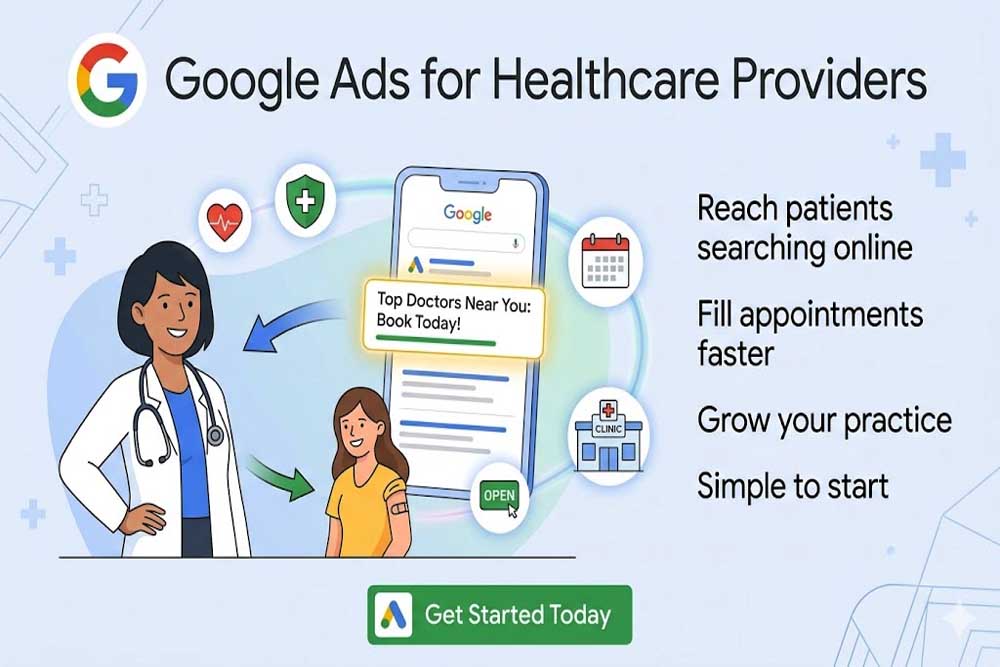
When someone searches “dermatologist near me” or “dental implants Dubai cost,” they’re already in problem-solving mode. They want a solution. Your ad shows up exactly at that moment. That’s why paid search, also called PPC (pay-per-click), delivers higher ROI than almost any other digital channel, especially in healthcare.
Think about it from a patient’s perspective. Someone who searches “pediatric cardiologist Dubai” is not casually browsing. They have a child with a heart condition. They need a specialist. They’re ready to book. If your clinic’s ad appears at the top of that page with a clear message and a phone number, you’ve already done most of the selling before they even click.
This is why Google Ads campaigns, when built correctly, are the single fastest way for healthcare providers to reach high-intent patients.
What “High-Intent” Actually Means in Healthcare Advertising
Intent is everything. Not all searches are created equal, and the best Google Ads for healthcare provider campaigns understand this at a deep level.
Someone searching “what causes lower back pain” is researching. They’re curious, not ready to book.
Someone searching “spine specialist consultation Dubai” is ready to act.
The keywords you target, and the ones you exclude, determine whether your budget reaches people who are ready to convert, or people who are just browsing. This distinction directly affects your cost per acquisition.
At Digital Oasis, the first thing we look at when auditing a healthcare client’s existing campaigns is keyword intent alignment. Are the ads targeting informational queries? Are there obvious negative keywords missing? Are long-tail, high-intent phrases being ignored in favour of broad, expensive terms?
The Three Keyword Match Types You Need to Understand
Broad match casts a wide net. It can bring volume, but it often attracts irrelevant traffic.
Phrase match is more refined, your ad shows when someone’s search includes your keyword phrase, in that order.
An exact match is the sharpest tool. Your ad only appears when the search matches your keyword’s meaning very closely.
For healthcare, a balanced strategy typically leans on phrase and exact match, with broad match used carefully and always paired with a strong negative keyword list.
Keyword Research Google Ads for Healthcare Providers: It’s Not Just About Volume
One of the most common mistakes healthcare practices make is targeting keywords based on search volume alone. High volume sounds good until you realize half those clicks come from people who aren’t your target patients.
When building keyword strategies for clinics, hospitals, and specialist providers, we look at:
Service-specific terms: “IVF clinic Dubai,” “LASIK eye surgery Abu Dhabi,” “psychiatrist for anxiety Dubai.”
Symptom + solution terms: “knee pain treatment,” “hair loss doctor near me.”
Low-funnel buying signals: words like “cost,” “price,” “appointment,” “book,” and near me.”
Long-tail phrases: these are longer, more specific searches that signal high intent and often cost less per click because fewer competitors bid on them.
Negative keywords are equally important. Terms like “free,” “jobs,” “how to become,” “salary,” and “DIY” should almost always be excluded from healthcare provider campaigns. Without negatives, you’re paying for clicks from people who will never become patients.
Landing Pages: Where Most Healthcare Campaigns Fail
Here’s something a lot of agencies won’t tell you: your ad is not the problem. Your landing page is.
Sending paid traffic to your homepage is one of the most expensive mistakes in healthcare marketing. Your homepage serves many audiences — patients, job seekers, investors, and media. But someone clicking an ad for “diabetes management specialist Dubai” needs to land on a page that speaks specifically to diabetes management.
When the ad message matches the landing page message exactly, conversion rates jump. This is called message match, and it’s fundamental to Google’s Quality Score — the internal metric Google uses to determine how much you pay per click.
A well-optimized landing page for a healthcare ad campaign should include:
- A headline that mirrors the ad copy
- A simple, mobile-friendly design
- A clear form or click-to-call button above the fold
- Trust signals — credentials, certifications, patient reviews
- No distracting navigation menus that pull the visitor away
Digital Oasis handles landing page audits and recommendations as part of every Google Ads campaign we manage, because traffic without conversion is just burning budget.
Campaign Structure: The Architecture That Determines Everything
Behind every high-performing Google Ads campaign is a clean, logical structure. Most healthcare providers who run their own ads, or who’ve worked with generalist agencies, have campaigns that look like a tangled mess — broad ad groups, mixed intent keywords, no clear separation between services.
The right structure typically looks like this:
Each major service gets its own campaign. Within each campaign, tightly themed ad groups separate out specific treatments or conditions. Each ad group has ad copy written specifically for that theme. Each ad group points to a landing page built for that specific service.
This granularity gives you control. You can see which services are performing, where to increase the budget, and where to pull back. You can test different messages for different conditions. You can pause underperforming ad groups without affecting your entire account.
Location Targeting for Healthcare Providers in Dubai and the GCC
One of Google Ads’ most powerful features for healthcare is location targeting — and in the Dubai and GCC market, this matters enormously.
A patient looking for a clinic will almost always prefer one nearby. Someone in Jumeirah is not going to drive to Al Quoz if there’s a comparable option closer. Your ads should reflect this geographic reality.
We set up location targeting to prioritize the areas where your ideal patients actually live and work. For multi-location clinics or hospital groups, each location gets its own campaign structure — so performance data is clean, and the messaging can be localized.
For healthcare providers serving specific communities or nationalities within the UAE, demographic layering adds another dimension. Age, household income signals, and device targeting let you reach the right people within the right geography.
Smart Bidding: Let the Data Work for You
Google’s AI-driven bidding strategies have matured significantly. In 2026, manual bidding for most healthcare campaigns makes less sense than it did three years ago. Smart bidding strategies like Target CPA (cost per acquisition) and Target ROAS (return on ad spend) use machine learning to optimize bids in real time — considering hundreds of signals simultaneously.
That said, smart bidding needs data to work. A new campaign with no conversion history is not ready for Target CPA. You build toward it, starting with Maximize Conversions, gathering data, and then transitioning as the algorithm learns your account’s patterns.
One thing that does not change with smart bidding: your conversion tracking has to be set up correctly. If the system doesn’t know what a conversion looks like — a form submission, a phone call, an appointment booking — it cannot optimize toward it. This is another area where many healthcare practices are flying blind.
Tracking, Reporting, and the Metrics That Matter
If you’re running Google Ads and your only metric is “how many clicks did we get,” you’re measuring the wrong thing.
Clicks are vanity. Conversions are valuable.
Click-Through Rate (CTR) tells you how compelling your ad copy is. A low CTR means your messaging isn’t connecting, your keywords are too broad, or competitors are outbidding you.
Conversion Rate tells you what happens after the click. This is where the landing page comes in.
Cost Per Conversion is the number that actually matters. How much did it cost to get one phone call, one form submission, one booked appointment?
Quality Score is Google’s internal rating of your ad relevance, landing page experience, and expected CTR. Higher scores mean lower costs. Improving quality score is not a one-time task, it’s ongoing work.
The best campaigns are reviewed weekly, not monthly. Markets shift, competitors adjust their bids, and search behavior changes. Campaigns that aren’t monitored closely drift toward inefficiency.
Why Healthcare Google Ads Needs a Specialist, Not a Generalist
Healthcare advertising is not like selling shoes. Google has specific policies around medical content. Claims need to be accurate. Certain treatments and conditions are subject to ad approval restrictions. Landing pages are held to higher standards of accuracy and credibility.
Working with an agency that has no healthcare experience means learning these lessons on your budget and your time.
Digital Oasis has managed Google Ads campaigns specifically for healthcare clients — clinics, hospitals, specialist practices, dental chains, aesthetics providers — across Dubai and the wider GCC. We understand the regulatory environment, the patient psychology, and the technical requirements of building campaigns that perform in this space.
We offer Google Ads services built specifically around healthcare provider goals: patient acquisition, appointment bookings, and measurable cost-per-lead reduction. If your organic visibility needs work alongside your paid campaigns, our SEO services ensure you’re building long-term equity while the ads drive immediate results.
The Six-Month Reality Check
There’s a truth in paid search that good agencies tell clients upfront: you need at least six months to fully optimize a campaign.
The first two months are about building structure, gathering data, and making initial adjustments. Months three and four are where you start seeing meaningful conversion improvements. By months five and six, you’re refining a system that’s working — reducing wasted spend, scaling what’s performing, and continuously improving quality scores.
This is not a reflection of slow results. It’s a reflection of how machine learning, A/B testing, and campaign optimization actually work. Anyone promising overnight results in Google Ads for healthcare is either lying or about to waste your money.
The patience pays off. Healthcare clients who work with us through the optimization cycle consistently see cost-per-lead improvements of 30-50% between month one and month six.
People also ask
How much should a healthcare provider spend on Google Ads?
There’s no universal answer, but in competitive markets like Dubai, starting budgets for single-specialty clinics typically range from AED 3,000 to AED 10,000 per month. This varies significantly by specialty and competition.
Can dentists and aesthetic clinics advertise on Google?
Yes, but certain claims and services have restrictions. An experienced healthcare ads specialist knows how to navigate these policies without getting ads disapproved.
How long before we see results?
Most clients see initial lead flow within the first two weeks of a well-structured campaign launch. Meaningful optimization and cost efficiency improvements take three to six months.
What’s the difference between Google Ads and SEO for healthcare?
SEO services build organic visibility over time — six to twelve months typically for competitive healthcare terms. Google Ads delivers immediate placement. The strongest healthcare marketing strategies use both: paid for immediate patient flow, organic for long-term authority.
Can you manage Amazon Ads for healthcare products, too?
Yes — if you sell healthcare products, supplements, or medical equipment online, our Amazon Ads services cover product listing optimization and sponsored placement strategy.
Final Thoughts
Google Ads is not magic. It’s math, strategy, and relentless attention to detail.
For healthcare providers in Dubai and the GCC, it’s also one of the most direct paths to consistent patient growth — when it’s done right. The difference between a campaign that burns budget and one that books patients every day usually comes down to keyword intent, ad copy quality, landing page relevance, and how closely someone is watching the data.
If you’ve tried Google Ads before and it didn’t work, the campaign was probably the problem — not the platform.
Digital Oasis has built and managed campaigns for doctors, therapists, hospital networks, dental chains, and aesthetic clinics across the region. We don’t sell packages. We build strategies.
If you want to talk about what a properly structured Google Ads campaign could do for your practice, reach out to the Digital Oasis team directly through digitaloasisae.com.

Best Google Ads Agency for Events and Exhibitions
Best Google Ads Agency for Events and Exhibitions
Picture this. Your exhibition hall is booked. The booth looks stunning. The speakers are confirmed. But on the day of the event, the seats are half-empty — and so is the registration page. Sound familiar? It is more common than you think, and it almost always comes down to one thing: the wrong marketing strategy.
Events have a ruthless deadline. Unlike a product that sits on a shelf, an event disappears after a single date. Every day without the right traffic is a day of lost registrations. That is exactly why Google Ads for events and exhibitions is not optional — it is the sharpest tool in your marketing arsenal.
At Digital Oasis, we have run hundreds of event-specific campaigns across the UAE. What we have learned is simple: when it is done right, Google Ads fills halls, sells tickets, and drives booth traffic faster than any other channel.
Why Google Ads Is the Right Choice for Events and Exhibitions
Ask yourself — where do people go the moment they hear about an upcoming exhibition? They search for it. Google captures that exact moment of curiosity, and that is what makes it so powerful for events.
The Buying Window Is Short — Act Fast
Unlike e-commerce or B2B services, event marketing runs on a tight clock. Research by Think with Google found that 57% of event-related searches happen within the final two weeks before an event. It is critical to have your ads live long before that window, so your campaign builds momentum and does not play catch-up.
A well-structured Google Ads campaign can scale your budget precisely across that window — heavy spend in the weeks leading up to the date, a final surge in the last 48 hours. No other paid channel gives you that level of calendar-aware control.
Intent-Driven Traffic vs. Passive Audiences
Social media puts your event in front of people who may be interested. Google puts it in front of people who are already looking. That distinction matters enormously.
When someone types “trade exhibitions Dubai 2026” or “events in Abu Dhabi this weekend,” they are not passively scrolling. They are ready to act. It is important to know that search-intent traffic converts at a significantly higher rate than interest-based targeting on social platforms. According to WordStream data, the average Google Ads conversion rate across industries is 4.4% on search, and event-specific campaigns often outperform that.

Google Ads Campaign Types That Drive Event Success
Not every campaign type works for every event. The right combination depends on your goal — are you selling tickets, filling conference seats, or driving booth visits from industry buyers?
Search Campaigns for Ticket and Registration Traffic
Search ads are the foundation. Target keywords like “conferences in Dubai,” “exhibition stands UAE,” or “industry events 2026” to capture buyers at the exact moment of intent. Well-crafted ad copy with a clear call-to-action — “Register Before Seats Fill Up” — drives direct clicks to your landing page.
It is also worth using ad extensions. Sitelinks can point to the speaker lineup, the agenda, and the venue map. Callouts can highlight “Free Entry,” “Limited Spots,” or “Early Bird Discount.” Each extension increases the ad’s real estate on the search page and boosts click-through rates.
Display Campaigns for Exhibition Brand Awareness
Before people search, they need to know your event exists. Display campaigns reach users across millions of websites, apps, and Gmail inboxes. Use bold visual creatives with your event date, venue name, and a strong hook. Retargeting is especially powerful here — reach people who visited your event page but did not register.
YouTube Ads for Event Teasers and Countdowns
A 30-second teaser of last year’s event, or a countdown video featuring your keynote speaker, builds anticipation fast. YouTube pre-roll ads allow you to target by interest, demographics, and even custom audiences who searched for related events. It is a channel that most event marketers underestimate.
Performance Max for Omnichannel Event Reach
Performance Max campaigns use Google’s AI to serve ads across Search, Display, YouTube, Gmail, and Maps simultaneously. Feed it strong assets — event images, video clips, ad copy variations — and it learns which combinations drive registrations at the lowest cost. For large-scale exhibitions, it is one of the most efficient budget tools available.
How Digital Oasis Builds Google Ads Campaigns for Events
At Digital Oasis, we do not run generic campaigns. Every event campaign we build starts with a brief that answers three questions: Who is attending? Where are they located? What do they need to see before they register?
Audience Segmentation for Event Attendees
We segment audiences by industry, job title, past event behavior, and location. A B2B manufacturing exhibition in Dubai needs a completely different audience strategy than a consumer lifestyle expo in Sharjah. Get the audience wrong, and even the best ad copy will underperform.
Geo-Targeting for UAE and Regional Exhibitions
The UAE has a highly transient, multinational population. It is critical to layer geo-targeting carefully — targeting residents, visitors, and regional travelers from Saudi Arabia, Qatar, and Kuwait who attend major UAE exhibitions. Our campaigns adjust bid modifiers by location to maximize spend efficiency.
Conversion Tracking — From Click to Footfall
Clicks are vanity. Registrations are sanity. We set up conversion tracking across every touchpoint — form submissions, ticket purchases, phone calls, and for physical events, QR code scans at the venue entrance. This data feeds back into the campaign and sharpens performance week over week.
If you want to see how we approach paid traffic across industries, explore our Google Ads services to understand the full scope of what we offer.
Google Ads vs. Other Channels for Event Promotion
It is a fair question — why not just use Instagram, LinkedIn, or email?
Why SEO Alone Is Too Slow for Events
SEO is a long-term investment. It builds authority and organic traffic over months. It is essential for your brand — and our SEO services are designed to do exactly that. But SEO cannot rank a new event page in time for a deadline three weeks away. It is the wrong tool for a time-sensitive campaign. Google Ads fills that gap immediately.
Why Social Ads Miss High-Intent Buyers
LinkedIn and Instagram work on interest and demographic targeting. They are effective for building awareness, but they reach people who may or may not be looking for your event right now. Google Search captures the moment of active intent — and that is irreplaceable for events with a registration deadline.
What about Amazon Ads? They are exceptional for product-based event merchandise, branded giveaways, or equipment related to your exhibition category. Our team integrates an Amazon advertising strategy alongside Google for clients who sell products adjacent to their events.
People Also Ask
How much should I spend on Google Ads for an event?
It depends on your event size, duration, and target audience. A local corporate seminar may run well on AED 3,000–5,000 total. A large trade exhibition in Dubai may require AED 30,000 or more to saturate the relevant audience. Start with a clear cost-per-registration goal and work backward from there.
How early should I start Google Ads for an exhibition?
Start at least six to eight weeks before the event date. The first two weeks allow the campaign to learn and optimize. The final four weeks carry the heaviest spend. Waiting until the last two weeks is a costly mistake — the algorithm has no time to learn.
Can Google Ads drive physical footfall to exhibitions?
Yes. Location extensions, Google Maps ads, and geo-targeted search campaigns are specifically built for physical venue traffic. Add a call extension and a directions CTA for the best results. Many of our UAE clients saw a 30–40% increase in walk-in traffic after adding location-based ad layers.
What is the best Google Ads campaign type for events?
Search campaigns capture intent. Display retargeting keeps your event top-of-mind. Performance Max scales across channels. It is rarely one campaign type — the best results come from combining at least two or three types with a unified budget strategy.
Final Thoughts
Events are unforgiving. Miss the registration window, and you cannot recover it. The right Google Ads strategy does not just fill seats — it builds anticipation, creates urgency, and converts searchers into attendees at a speed no other channel can match.
At Digital Oasis, we combine deep campaign expertise with local UAE market knowledge to make every dirham of your event ad budget count. Do not wait until two weeks before the door opens.
Ready to fill your next event? Contact Digital Oasis today and let us build a campaign that sells out your exhibition before the countdown ends.

Affordable Google Ads Services in Dubai for Small Businesses — What’s Possible
Most small business owners in Dubai hear “Google Ads” and immediately picture a big agency invoice and a campaign that burns through budget like a broken tap. That fear is understandable — but it’s also keeping a lot of genuinely good businesses invisible online. The reality is, affordable Google Ads services in Dubai for small businesses do exist, and when set up correctly, they punch well above their weight.
I’ve spoken with salon owners in Deira, boutique clinics in Jumeirah, and e-commerce startups in Dubai Silicon Oasis — all sharing the same frustration. They either tried Ads themselves and got burned or assumed it wasn’t for them financially. Both conclusions were premature.
This post breaks down what’s actually possible, what it realistically costs, and how to stop handing money to Google without a plan.
What Google Ads Actually Costs a Small Business in Dubai
Let’s get the uncomfortable conversation out of the way first.
Google Ads operates on a pay-per-click model. You don’t pay to show up — you pay when someone clicks. In Dubai, average CPCs (cost-per-click) across industries typically range from AED 1.50 for lower-competition niches to AED 25+ for sectors like legal services or real estate. For most local service businesses — think home cleaning, photography, tutoring, or F&B — you’re working with something in the AED 3–8 range.
A monthly ad spend of AED 1,500–3,000 is enough to generate meaningful traffic for many small businesses in Dubai, especially when campaigns are tightly structured around high-intent keywords. The problem isn’t usually the budget — it’s a misdirected budget.
According to WordStream’s industry benchmarks, the average small business wastes up to 25% of its Google Ads spend on irrelevant clicks. That’s not a Google problem. That’s a setup problem.
Why Most Small Business Campaigns Fail — And It’s Not the Budget
There’s a pattern worth naming. A business owner sets up their own campaign, picks broad match keywords, sets a daily budget, and checks back two weeks later, wondering why they got clicks but zero calls.
Here’s what typically went wrong:
No negative keyword list. If you’re a cleaning company in Dubai Marina, you don’t want clicks from someone searching “cleaning jobs Dubai.” Without negatives, you’ll pay for that click every time.
Wrong match types. Broad match keywords in a competitive market like Dubai are usually a budget drain unless paired with Smart Bidding and solid conversion data — which most new campaigns don’t have yet.
Landing page disconnect. Someone clicks your ad for “affordable AC repair Dubai” and lands on your generic homepage. They leave. Google notes the bounce. Your Quality Score drops. Your CPC goes up. It’s a spiral.
No conversion tracking. If you don’t know which keywords are bringing phone calls or form fills, you’re flying blind. This is the single most damaging mistake small businesses make.
A well-managed campaign addresses all of this upfront — not after three months of wasted spend.
What “affordable Google Ads services in Dubai for small businesses ” Actually Means in a Dubai Context
The word affordable gets stretched a lot in marketing. So let me be direct about what it should mean for a small business.
Affordable doesn’t mean cheap management that sets your campaign once and disappears. It means a management fee that’s proportional to your ad spend, with transparent reporting and active optimization. Paying AED 800/month in management fees on an AED 1,500 ad spend doesn’t make sense. Neither does paying AED 5,000 in fees for a AED 3,000 campaign.
A reasonable benchmark: management fees should sit around 15–25% of your monthly ad spend for small accounts, or a flat monthly retainer that scales sensibly. Anything outside that range deserves scrutiny.
When evaluating any agency or freelancer for Google Ads management, ask three questions:
- Do you provide monthly performance reports with actual data, not just screenshots?
- Who owns the Google Ads account — us or you?
- What does your onboarding process look like before the first dirham is spent?
If an agency hesitates on question two, walk away. You should always own your own account.
The Campaigns That Work Best for Small Dubai Businesses
Not every campaign type makes sense at every budget level. Here’s a realistic breakdown.
Search Campaigns are the backbone for most small businesses. High intent, direct targeting, measurable. A cafe in Business Bay targeting “specialty coffee near me” or “breakfast spot Dubai” will see results faster here than anywhere else.
Performance Max campaigns have become increasingly useful for businesses with physical locations. They use Google’s AI to show ads across Search, Display, YouTube, Gmail, and Maps simultaneously. For small businesses with a local focus, they can be cost-efficient — but they need proper asset creation and goal setup to perform well.
Local Service Ads (available for select categories) show above regular search results and operate on a pay-per-lead model rather than pay-per-click. If your category qualifies, these are worth exploring alongside traditional search.
Display and YouTube are generally better suited for brand awareness rather than direct response on small budgets. Unless you have a strong creative asset and a clear funnel, hold these back until search is working.

What a Good Month of Google Ads Looks Like for a Small Business
Let me paint a realistic picture — not a best-case scenario.
A small tutoring center in Dubai with an AED 2,500/month ad budget and proper campaign management can realistically expect 80–150 clicks per month on well-chosen keywords. If the landing page converts at a conservative 8%, that’s 6–12 enquiries per month. If they close half of those as paying students, that’s 3–6 new enrollments from a single channel.
Multiply that by lifetime student value, and the math works. But only if the campaign is structured correctly and the landing page does its job.
This is also where SEO services become a complementary investment rather than a competing one. Ads give you immediate visibility while organic rankings build over time. Running both in parallel — even at modest budgets — means you’re not entirely dependent on paid traffic, and your cost-per-acquisition drops as organic starts contributing.
Red Flags to Watch When Hiring a Google Ads Agency in Dubai
The Dubai digital marketing market is crowded. Not everyone offering “affordable Google Ads management” is worth what they charge — or even what they don’t charge.
Watch out for agencies that:
- Guarantee specific rankings or ROAS percentages before seeing your account
- Won’t give you access to your own Google Ads account
- Report on impressions and clicks, but never on actual leads or sales
- Lock you into 12-month contracts without performance clauses
- Use vanity metrics (“We got you 10,000 impressions!”) to mask poor conversions
A genuinely good Google Ads partner will talk about business outcomes first and metrics second. They’ll want to understand your average customer value before recommending a budget. And they’ll be honest when a campaign needs time, not just more spending.
Why Google Ads Works So Well for Small Businesses
- Quick visibility: your ads can appear at the top of Google the same day the campaign goes live.
- Targeted reach: show ads only to people in specific Dubai areas, languages, devices and times of day.
- Full cost control: set daily budgets and pay only when someone clicks.
- Clear tracking: see exactly which keywords bring calls, forms and WhatsApp leads.
- Easy to scale: increase budget on campaigns that are profitable and pause the rest.
- Shopping ads for e-commerce: show products with image and price directly in search results.
Which Small Businesses Benefit Most from Google Ads?
Google Ads works best for businesses where customers search with clear intent: home services, clinics, real estate, legal and financial services, education, car services and e-commerce stores. If people search for what you sell, Google Ads can put you in front of them at the moment they are ready to buy.
5 Things to Get Right Before You Spend
- Budget allocation: focus a limited budget on your most profitable service and area first.
- Keyword selection: choose specific, high-intent keywords and add negatives from day one.
- Ad copy and landing pages: each ad should send people to a page that matches the search exactly.
- Conversion tracking: track calls, forms and WhatsApp clicks before optimizing anything.
- Weekly monitoring: review search terms, bids and budgets every week to stop waste.
People also ask
How much should I spend on Google Ads as a small business in Dubai? A starting budget of AED 1,500–3,000/month is workable for most local service businesses. E-commerce brands may need more depending on category competitiveness.
Can I run Google Ads myself without an agency?
Technically yes. Practically, the learning curve costs money. Most business owners find that self-managed campaigns underperform managed ones by 30–40% in the first six months due to structural mistakes.
How long before I see results from Google Ads?
Search campaigns can show results within days. But meaningful optimization data typically takes 4–6 weeks of consistent running. Don’t judge a well-set-up campaign in the first two weeks.
What’s the difference between Google Ads and SEO?
Google Ads puts you at the top of results immediately — paid. SEO builds organic rankings over time — free clicks, but slower. Both belong in a long-term growth strategy.
Do Google Ads work for e-commerce businesses in Dubai?
Yes, particularly Shopping campaigns and Performance Max. If you’re running an online store and also selling on marketplaces, combining Google Ads with Amazon Ads creates multi-channel coverage that maximizes visibility across where people are actually searching and buying.
Final Thoughts
Running affordable Google Ads services in Dubai for small businesses isn’t about finding the cheapest option — it’s about finding the most efficient one. A AED 2,000/month campaign that generates consistent leads beats an AED 10,000/month campaign that generates noise.
What separates businesses that grow from those that stall is rarely the budget. It’s usually structure, clarity on goals, and the discipline to optimize rather than just spend.
If your current approach to paid advertising isn’t working — whether that’s self-managed campaigns, an agency that’s gone quiet, or simply not starting yet — the path forward is simpler than it looks. Start with a search. Track everything. Optimize weekly. And if you need support building campaigns that actually convert, that’s exactly what we do at Digital Oasis.

What’s Included in a Professional Google Ads Audit in Dubai?
You’re spending thousands of dirhams every month on Google Ads. The campaigns are running. The clicks are coming in. But conversions? They’re either flatlined or nowhere near what your budget deserves.
Here’s the uncomfortable truth most agencies won’t say out loud: running Google Ads without auditing them regularly is like driving with your eyes half-closed. You might stay on the road for a while — but eventually, the budget bleeds out quietly, and you don’t even notice until it’s too late.
At Digital Oasis, we’ve audited hundreds of Google Ads accounts across Dubai and the wider UAE, and the pattern is almost always the same. Wasted spend hiding in plain sight. Keywords: eating budget with zero commercial intent. Ad copy that gets impressions but no clicks. Landing pages that load like it’s 2008.
A proper Google Ads audit doesn’t just find problems — it maps out exactly where your money is going, what’s working, and what needs to change right now. Let’s break down what that actually looks like.
Why Dubai Businesses Need a Google Ads Audit More Than Ever
Dubai’s digital advertising landscape in 2026 is genuinely competitive. Sectors like real estate, e-commerce, hospitality, and professional services are bidding hard, and cost-per-click figures in some industries have jumped significantly over the last two years.
According to WordStream’s industry benchmarks, average Google Ads conversion rates across industries sit between 2% and 5%. If your campaigns are pulling less than that — or worse, you don’t know your conversion rate at all — that’s your first red flag.
The Dubai market also has layers that global-generic campaigns miss entirely. Language targeting (Arabic vs. English), seasonal spikes around Ramadan, Expo-era consumer behavior shifts, and hyperlocal audience intent all play a role in whether your ads actually land. A Google Ads audit calibrated for the UAE market addresses all of this — not just the surface-level metrics.
What a Professional Google Ads Audit Actually Covers
Account Structure and Campaign Setup
This is where most audits should begin, and where most DIY attempts stop too early.
A well-structured Google Ads account separates campaigns by objective, audience intent, and budget priority. In reality, most accounts we review have everything lumped together — brand and non-brand terms competing against each other, broad match keywords running without supervision, and ad groups so bloated they’ve lost any meaningful theme.
During an audit, every campaign is reviewed for logical structure, match type discipline, and whether the setup actually reflects business goals. If your campaign for Google Ads management services is competing against your own branded searches, you’re essentially paying twice for the same customer.
Keyword Analysis — The Heart of Every Audit
Keywords deserve their own section because this is typically where the biggest waste happens.
We look at three things during keyword analysis:
Search term reports — What are people actually searching when they trigger your ads? This report reveals mismatches between what you’re targeting and what you’re actually showing up for. One Dubai e-commerce client we worked with was spending 30% of their budget on searches that had nothing to do with their products — all from a single broad match keyword left unchecked.
Negative keyword gaps — Missing negatives are silent budget killers. Every irrelevant search term that triggers your ad costs money. Building a thorough negative keyword list is one of the fastest ways to reduce wasted spend without touching your bids.
Keyword intent alignment — Are your keywords matched to where the buyer is in their journey? Informational queries need different landing pages than transactional ones. Mixing them up tanks your Quality Score and conversion rate simultaneously.
Quality Score Deep Dive
Quality Score is Google’s way of grading how relevant your ads, keywords, and landing pages are to each other. It affects both where your ad ranks and what you pay per click. A score of 7 or above typically means you’re in good shape. Below 5, and you’re paying a premium for worse positions.
An audit breaks Quality Score into its three components:
Expected CTR — Is your ad compelling enough that Google expects people to click it?
Ad relevance — Does your ad copy actually reflect what the keyword is about?
Landing page experience — Does the page people land on match what the ad promised, load fast, and give them a clear next step?
All three need to work together. Fixing one without addressing the others only gets you so far.
Conversion Tracking — You Can’t Optimise What You Can’t Measure
This one surprises business owners more than anything else. Roughly 40% of the accounts we review at Digital Oasis either have broken conversion tracking or no tracking at all. That means Google’s algorithm has been optimising campaigns in the dark — making automated bidding decisions based on incomplete or incorrect data.
A proper audit verifies:
Whether Google Ads and Google Analytics 4 are properly linked and sharing data. Whether conversion actions (form fills, calls, purchases, WhatsApp clicks) are set up and firing correctly. Whether view-through conversions are being counted in a way that inflates reported results. Whether the attribution model being used actually reflects how customers move through their buying journey.
Without clean tracking, every other optimization effort is guesswork.
Bidding Strategy — Are You Letting Google Spend Freely?
Automated bidding strategies like Target CPA and Target ROAS can be incredibly effective — when they have enough data to work with. The problem is that most accounts switch to smart bidding too early, before there are enough conversions for the algorithm to learn from.
During the audit, we review whether the current bidding strategy makes sense given the account’s conversion volume, budget, and business goals. An account getting 8 conversions a month probably shouldn’t be running Target ROAS. Manual CPC with strategic bid adjustments might outperform it significantly.
Device, location, and time-of-day adjustments get reviewed as well. Most accounts we look at have this data sitting right there in the dashboard — nobody’s acted on it. If your actual buyers are converting on desktop during work hours, but a chunk of your budget is running on mobile at midnight, that’s not a strategy problem. That’s just money leaving the account with nowhere useful to go.
Ad Copy and the Dubai Market — Not Just Clicks, the Right Clicks
Here’s something most agencies don’t talk about — buyers in Dubai think differently.
When someone searches “Google Ads agency Dubai,” they’re not just looking for a service. They want to know you’re trustworthy, that pricing won’t be a surprise, and that work starts soon. Especially in B2B and real estate, people in the UAE quietly check three things before making a decision, a rough sense of cost, some proof you’ve done this before, and how fast you respond. If your ad copy doesn’t speak to any of that, you might get the click, but you won’t get the conversion.
That’s why, during an audit, we look specifically at whether your headlines carry any real signal. Writing “Best Google Ads Agency” tells nobody anything. Writing “Google Ads Audit Dubai, Results in 7 Days”, now that’s something a serious buyer actually responds to.
Landing Pages — Where the Money Actually Disappears
The ads can be perfectly written. But if the user lands on a slow, confusing page, every dirham spent getting them there is wasted.
We reviewed one Dubai e-commerce account where the CTR was genuinely impressive — sitting above 6%. Conversions, though? Nearly zero. The problem wasn’t the ad at all. It was the page. On mobile, it took over 6 seconds to load, and the “Buy Now” button was buried below the fold, meaning users had to scroll just to see it. Most didn’t bother.
During a landing page review, we look at three things specifically:
How fast the page loads—Google’s Core Web Vitals benchmark is 2.5 seconds, and Dubai users on mobile are particularly quick to leave if a page drags. Whether the page actually delivers what the ad promised—if your ad says “Free Google Ads Audit” and the page is a generic services overview, people bounce immediately. Whether the path to conversion is obvious—where’s the form, what does the CTA actually say, is the next step clear, or does the user have to figure it out themselves.
If you’re running SEO services alongside paid ads, these landing pages can genuinely serve both channels well—but only when they’ve been built with both in mind. Otherwise, you end up with pages that half-work for paid and half-work for organic, and neither performs the way it should.
Budget — Spreading It Evenly Is Usually the Wrong Move
Honestly, equal budget distribution across campaigns is one of those things that feels fair but rarely is.
Think about it this way. If you have eight campaigns running and you split the budget more or less evenly, you’re essentially treating a campaign that brings in leads like it’s the same as one that’s been quietly burning through spend for months. We see this constantly — pull the data on almost any account we audit, and there are one or two campaigns doing the heavy lifting while the rest are just… there. Active, spending, but contributing almost nothing to actual business results.
The fix isn’t complicated, but it does require someone to actually look at the numbers rather than just keeping things tidy. Money should follow performance, not the other way around.
Dubai adds another layer to this that a lot of advertisers ignore completely. This market has genuine seasonality, and it’s not the same seasonality you’d plan for in Europe or the US. Ramadan changes when people are online — evening and nighttime searches go up noticeably, and campaigns scheduled for a standard 9-to-5 window miss a chunk of that activity. Retail picks up around National Day in ways that catch underprepared advertisers off guard. And from October through February, when the weather cools, and tourists arrive in numbers, certain industries — hospitality, dining, leisure, anything experience-driven — see demand they simply won’t see again until the following winter.
Running the same budget at the same time throughout the entire year means you’re adequately funded during the slow months and under-resourced exactly when demand peaks. That’s a budget problem, but it’s really a planning problem underneath.
People also ask
How long does a Google Ads audit take?
For a typical mid-sized account, a proper audit takes three to five business days. Accounts with multiple campaigns, languages, or regional targeting take a bit longer — but a rushed audit isn’t worth much, so we don’t cut corners on time.
How often should I audit my account?
A full audit every three months is a solid habit for any active account. In between, you should be watching CTR, CPA, and conversion rate monthly — that way, problems surface early rather than after months of wasted spend.
Can I audit my own account?
You can look at the dashboard and pull basic numbers, sure. But the things that actually cost money — what’s happening inside your Quality Score, whether tracking is firing correctly, which search terms are silently draining budget — those are easy to miss without experience. And in most accounts, that’s exactly where the biggest waste is hiding.
What’s the difference between a free and a paid audit?
Free audits are almost always automated. A tool scans your account and spits out a checklist of generic recommendations. A paid audit means a real person sits with your account, understands what your business is actually trying to achieve, and gives you specific, prioritised actions. The difference is a bit like comparing an online symptom checker to seeing an actual doctor.
What does a Google Ads audit cost in Dubai?
It depends on how many campaigns you’re running, how complex the account is, and how deep the analysis needs to go. At Digital Oasis, we look at the account first, then give a quote — because auditing a three-campaign account and a twenty-campaign account are genuinely different jobs. Let’s have a conversation and figure out what you actually need.
Final Thoughts
People sometimes expect an audit to be a PDF that says, “fix this, fix that.” And honestly, if that’s all it is, it’s not worth much.
A real audit leaves you knowing where your money is going, where it’s actually coming back, and what the next move is. The numbers matter, but what matters more is understanding how your specific business is competing in Dubai’s market — and where the gaps are that nobody’s told you about yet.
We’ve sat with clients who genuinely believed their campaigns were performing well because the clicks were coming in. Once we went through the account, it turned out most of those clicks were coming from searches that had nothing to do with what they were selling. The people who were actually ready to buy weren’t seeing the ads at all.
Digital Oasis audits and rebuilds Google Ads accounts for businesses across the UAE — not to hand over a report, but to make the campaigns actually work. If you want to know honestly where your account stands in Dubai’s market right now, let’s talk.
