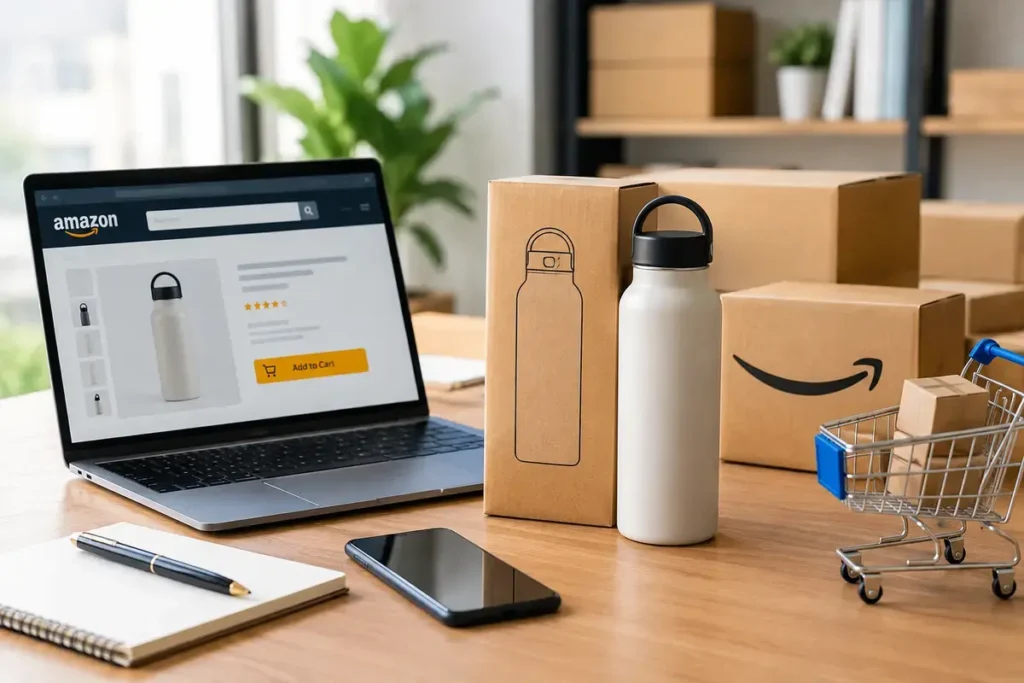
Amazon private label means selling a product made by a third-party manufacturer under your own brand name. You choose the product, branding, and price, and Amazon provides customers and, if you use FBA, fulfillment. It can be profitable, but only with solid research, a good supplier, and a launch plan.
We help brands launch and scale on Amazon, so this guide covers what actually matters at each stage. If you’d rather have a team handle it, see our Amazon FBA private label service.
What is Amazon private label?
With Amazon private label, a manufacturer produces the product, often with your tweaks to design, materials, or packaging. You sell it as your own brand. Because you own the brand, you set the price, the listing, and the customer relationship.
Compared with reselling other brands, you get:
- Better margins, since you’re not competing on someone else’s product with the same listing.
- A brand you can build, with repeat customers and a following beyond Amazon.
- Control over the product, so you can improve it from customer reviews.
- Lower startup costs than inventing a product from scratch.
Private label vs. Amazon’s own brands
These two get mixed up. Amazon also sells its own private-label lines, such as Amazon Basics and Amazon Essentials, which compete with third-party sellers. That differs from launching your own brand on Amazon. Amazon doesn’t publish its own private-label revenue, so be wary of any article quoting an exact figure. For verified marketplace numbers, see our Amazon statistics roundup.
How does Amazon private label work?
- Find the product. Look for steady demand, beatable competition, and a margin that survives fees and ads. Our Amazon product hunting service covers this stage.
- Find a supplier. Compare several manufacturers on Alibaba, Global Sources, or through a sourcing agent. Always order samples first. Our product sourcing guide explains how to vet suppliers, and our sourcing service can do it for you.
- Agree on the terms. Settle price, minimum order quantity (MOQ), lead time, quality checks, and payment terms in writing.
- Build the brand and packaging. You need a professional name, logo, packaging, and inserts. See our brand building and logo and packaging design services.
- Create the listing. Titles, bullets, images, and A+ content decide whether people click and buy. Start with Amazon listing optimization and professional product photography and video.
- Ship to Amazon. With Fulfillment by Amazon (FBA), your supplier ships inventory to Amazon’s warehouse (often via a prep center), and Amazon stores, packs, and delivers each order. Your supplier does not ship to customers.
- Launch and advertise. New listings need traffic and reviews. Plan this before inventory lands, using Amazon product launch services and Amazon PPC.
- Run it day to day. Customer messages, inventory, and account health need steady attention. Amazon account management takes this off your plate.
Is Amazon private label profitable?
It can be, but it isn’t automatic. Profit depends on:
- Demand: enough monthly searches and sales in the category.
- Competition: not dominated by brands with thousands of reviews.
- Landed cost: manufacturing, shipping, duties, and Amazon fees.
- Price: high enough to leave room for advertising.
- Brand and marketing: how well you stand out and convert.
Before you order inventory, work out your margin after fees, shipping, returns, and ad spend. Many new sellers only count product cost and are surprised by how much advertising takes. Our guide to common Amazon seller mistakes covers the errors that hurt margins most.
How to start an Amazon private label business
- Open a seller account on your target marketplace. For UAE sellers, check the current registration requirements on Amazon.ae.
- Validate your product idea with keyword data and competitor reviews.
- Order samples from at least three suppliers.
- Register a trademark so you can enroll in Brand Registry.
- Finalize branding, packaging, and compliance checks.
- Build a launch plan covering listing, images, pricing, and PPC.
- Send your first, smaller inventory order to FBA and test before scaling.
A small first order limits your risk. If it sells, you reorder with data behind you.
Requirements for Amazon private label
- An Amazon seller account, with the identity and business documents Amazon requires in your country.
- A product and a reliable supplier.
- A brand name and packaging.
- An optimized product listing.
- A fulfillment method: FBA or fulfilling orders yourself (FBM).
- Compliance: safety, labeling, and category-specific rules for the countries you sell in.
- A trademark and Brand Registry, which gives you brand protection tools and access to enhanced content. Amazon generally requires a registered or pending trademark to enroll.
- Business registration or licensing, depending on where you operate.
Amazon updates its policies often, so confirm current rules in Seller Central before you commit money.
How much does Amazon private label cost?
We can’t give you one honest number, because it depends on the product. Budget for these categories and get real quotes for each:
| Cost | What to include |
|---|---|
| Product development | Design, samples, prototypes, testing |
| Manufacturing | Unit cost multiplied by your first order quantity |
| Branding and packaging | Logo, packaging design, printing, inserts |
| Shipping and duties | Freight, customs, prep center fees |
| Amazon fees | Referral fee, FBA fees, storage |
| Listing assets | Photography, video, A+ content |
| Launch and advertising | PPC, promotions, early reviews |
| Operations | Account management, software, accounting |
Start with a small test order rather than a large one. For tips on managing stock once you’re live, read our guide to e-commerce inventory optimization. If you end up with slow-moving stock, see how to sell overstock inventory.
Amazon private label strategy that works
- Do product research properly. Don’t pick a product because it “looks easy.”
- Build a recognizable brand. Strong packaging and consistent messaging help you stand out.
- Optimize every listing for search. Use the keywords shoppers type, and rank organically with Amazon SEO. Our article on how an Amazon SEO consultant can improve product visibility goes deeper.
- Use ads to start sales velocity. Sponsored Products, Sponsored Brands, and Sponsored Display each have a role. See our Amazon PPC strategy article, or our guide to running successful ads on Amazon in Dubai.
- Protect your brand. Enroll in Brand Registry, monitor for hijackers and counterfeits, and report infringements.
- Build your own website and social channels. An owned site and audience reduce your dependence on Amazon. See our website design and development, Shopify development, and social media marketing services.
- Diversify your sales channels. Once Amazon is working, consider Noon, Walmart, Etsy, your own store, or TikTok Shop.
Why sell private label on Amazon?
- Margin: you control pricing and the supply chain.
- Loyalty: a strong brand earns repeat purchases.
- Differentiation: your own product means fewer direct price wars.
- Reach: you tap into Amazon’s existing customer base.
- Advertising: Amazon’s ad tools put you in front of buyers already searching.
It does take work, and not every product succeeds. Competition is real, and the marketplace changes constantly. Sellers who do well plan carefully and keep adapting.
Are you ready to launch?
Answer yes to these before you spend on inventory:
- I’ve validated demand with keyword and sales data.
- I know my margin after all fees and ads.
- I’ve tested samples from more than one supplier.
- My brand, packaging, and trademark plan are ready.
- I have a launch and advertising plan.
- I’ve reviewed Amazon’s current policies and category rules.
If several of these are a no, get help before you place a big order. Want a team to handle sourcing, listings, and ads? Talk to Digital Oasis about Amazon private label, and we’ll review your product idea.
FAQs
What is Amazon private label?
It’s selling a manufacturer-made product under your own brand on Amazon. You control branding, pricing, and the listing.
Is Amazon private label still profitable?
Yes, for sellers who pick a good niche, control costs, and plan advertising. Margins depend on your landed cost, Amazon fees, and ad spend.
How much money do I need to start?
It varies by product. Costs include samples, a first inventory order, branding, shipping, Amazon fees, listing assets, and launch advertising. Get supplier quotes before setting a budget.
Do I need Brand Registry?
It isn’t mandatory to sell, but it’s strongly recommended. It gives you brand protection tools and access to enhanced content. You’ll generally need a trademark first.
What’s the difference between private label and wholesale?
Wholesale means reselling existing brands. Private label means you own the brand and sell your own product.
Can I do Amazon private label from the UAE?
Yes. Check the current seller registration requirements on Amazon.ae, and plan for local logistics and compliance.
Should I use FBA?
Most private label sellers do, because Amazon handles storage, delivery, and customer service on shipping. Compare costs against your margin first.